3d Term, Week 6 🤩⚓️

22nd – 28th of February 2021

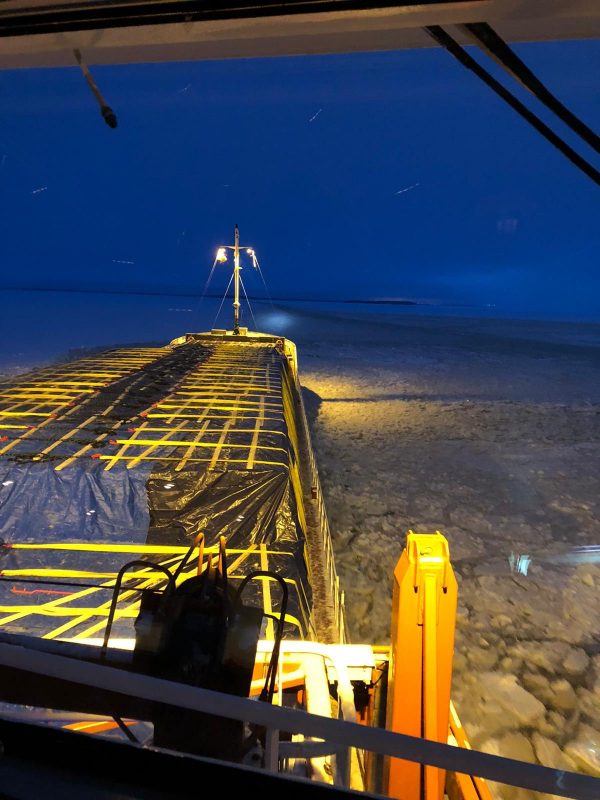
Riga!!!! Discharging the nice fertilizer loaded in Sluiskil! After a couple of days sailing in the Baltic, we arrived in Riga. It was an interesting trip for me because when entering the Gulf of Riga, we were regularly checking the ice maps for the ice situation. And it seem it was all clear for us till Riga, which was good. Maybe a bit more ice close to the coast. But then this happened: During my night watch, I found it strange that a ship ahead of me suddenly slowed down and almost stopped. That vessel was of course quite a few miles ahead of me, and there were also other vessels behind me and we had probably all checked the same ice charts that evening but….. As I saw the vessel strongly slowing down and only doing 2-3 knots of speed; I paid a little more attention to the horizon to try and figure out what was happening. Indeed, my route was not too far from hers so I didn’t want to be on a collision course with her but wanted to leave enough space in case she had some troubles and was drifting. But suddenly on the horizon, I could distinguish in the deep night so blurry greyish cover on the horizon. And there was a huge ice patch there and it was not mentioned on the ice charts!

Perfect conditions for discharging in Riga
The quayside in Riga still full of snow
Ruyter alongside in Riga, discharging fertilizer, the fog came up.

We did not have much choice to go through, but luckily Ruyter is an Ice class A vessel so she handles it well. Of course, the inevitable noise of ice scratching the hull surprised quite a few that night. Normal: they had expected a peaceful non-icy night and they suddenly felt as if we were stuck in ice again. Almost. I mean. It was a surprise for us. And also for the other vessels. The one ahead of us and… the ones behind us! The only thing you have to do is slow down the ship and enter slowly to not have any unwanted damages. Because of the ship ahead we knew the patch was not that big; but big enough to last a couple of hours pushing away the patch. It reminded me of when we would go on unchartered areas in Antarctica on board Bark Europa… slowly pushing and making sure everything was fine. Well; that happened and it was fun. It was my little story of the night, haha and I shall remember it well! « The unchartered big patch of ice in the Gulf of Riga ».

So there we were back in ice in the harbour. A nice blue sky the morning, all hatches open, but nice and fresh (read cold haha…) air outside. Good. I do not mind the cold anymore, right? All these cold showers are supposed to toughen me up, and after my experience at -17° in Finland… any temperature around the 0° should be warm too, is that not correct? There was also still snow on the quaysides! Amazing! It is funny how in these last posts, I have the feeling I have been only talking about timber cargo, ice and snow. But to be honest it is probably the only thing we talk about onboard: how cold it is going to be outside for cargo and mooring operations and what we have to do on deck for the lashings! Haha. Oh well.

the view from the porthole in my cabin

I was saying that the day started with a great blue sky so I opened up all hatches for discharging. But later during the day, it started to become foggy. I do not really like it when it is foggy because I never know what to expect. I know that in theory there is no rain with fog, but to my eyes, fog is only damp air; thus wet air and it is not that I get nervous with sensitive cargo, but I do find myself checking outside way more often than with blue sky. Fertilizer dissolves very fast with water, and would not want to have it on my hands that the cargo gets damaged because of me. Luckily it did not happen and we were discharged very smoothly.

Underway to Hamina , following the icebreaker

From Riga, we sailed in ballast to Hamina again to do our second timber voyage to Brake. Unlike Riga, Hamina was still completely covered in ice. There was so much ice that we actually got stuck in the ice! Yes yes! We tried pushing a bit but we were not going anywhere really. And if the pushing method works for smaller and already a bit broken ice; it doesn’t work at all for big thick unbroken patches. We had to call the ice breaker. Captain H. Called them and as they were not too far from us, they came directly to « rescue » us. I mean it is not a rescue in the literal sense; they are there to assist us. And that is what they did! They flew in to help us and passed next to us quite close to break the ice and create a waterway for us. It seems for them that it was normal sailing: no ice no nothing. Can you imagine the power they have? As you cannot move forward they just sail close by to help you out and create a gap so that you can sail through? It was pretty cool to see! We had to be fast to captain H. Directly followed him because otherwise the ice just closes back behind the ice-breaker and we are stuck again. We could almost sail our normal speed again….

Sailing in the ice
The bulb passing the ice when sailing

And we loaded in the same conditions as two weeks ago. Except that this time we did not have a full weekend waiting in the harbour. Oh and also the weather was not as nice with big sun and blue skies. We loaded directly the day after we arrived. This time I was more at ease. More at ease because I knew the cargo, I knew the plan as I had already seen it in action once and simply because I knew what was expected. As simple as that.

Alongside in Hamina, Finland

The sun of course only came out as we were sailing out of the harbour. I would not say it often happens like that but… yeah. The good thing about sailing in winter, compared to autumn for example; is that there are more high-pressure systems so the majority of the time it is blue skies and correct winds. While in autumn it can be horrible weather with very strong winds and depressions passing over the Baltic Sea one after the other. And that is very tiring.

Loading timber in Hamina

This time what was tiring was the lashing of the deck cargo; once again. But not the weather. As it was the second time we were doing it, we managed to get in a good rhythm and found a few tricks to make our lives easier. Working with the watch crane a bit more to lift the heavy parts for example. But it seems that there is no way to end up not making so many steps and back and forth to carry the slings and hooks and chains from one part to another of the ship. Unless having to storages, one fore and one aft; but it is not the case. We just put our « just do it » mentality on and… just did it; calmly but well. It is very important to double-check the lashing on deck because if it is not tight enough, cargo can fall and it becomes a big problem for the stability of the ship.

Departing Hamina in icy water

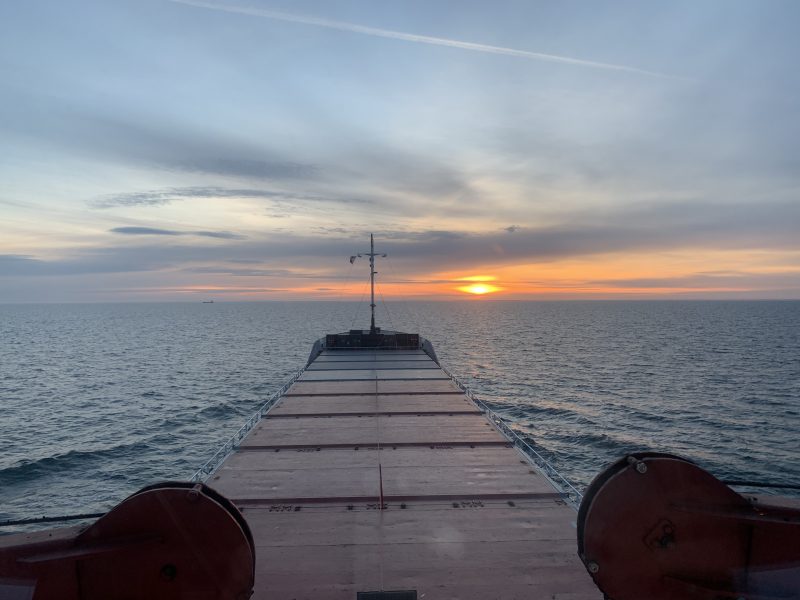
The lashing took place during the daytime and we easily sailed out in the middle of the afternoon for Brake. We managed to have a beautiful sunset too. I admit I do not get tired of sunsets at sea. I have a lot of pictures of them. When I see one I take a picture. It is always the same but different. Different colours, different clouds; but always as beautiful as the previous one.
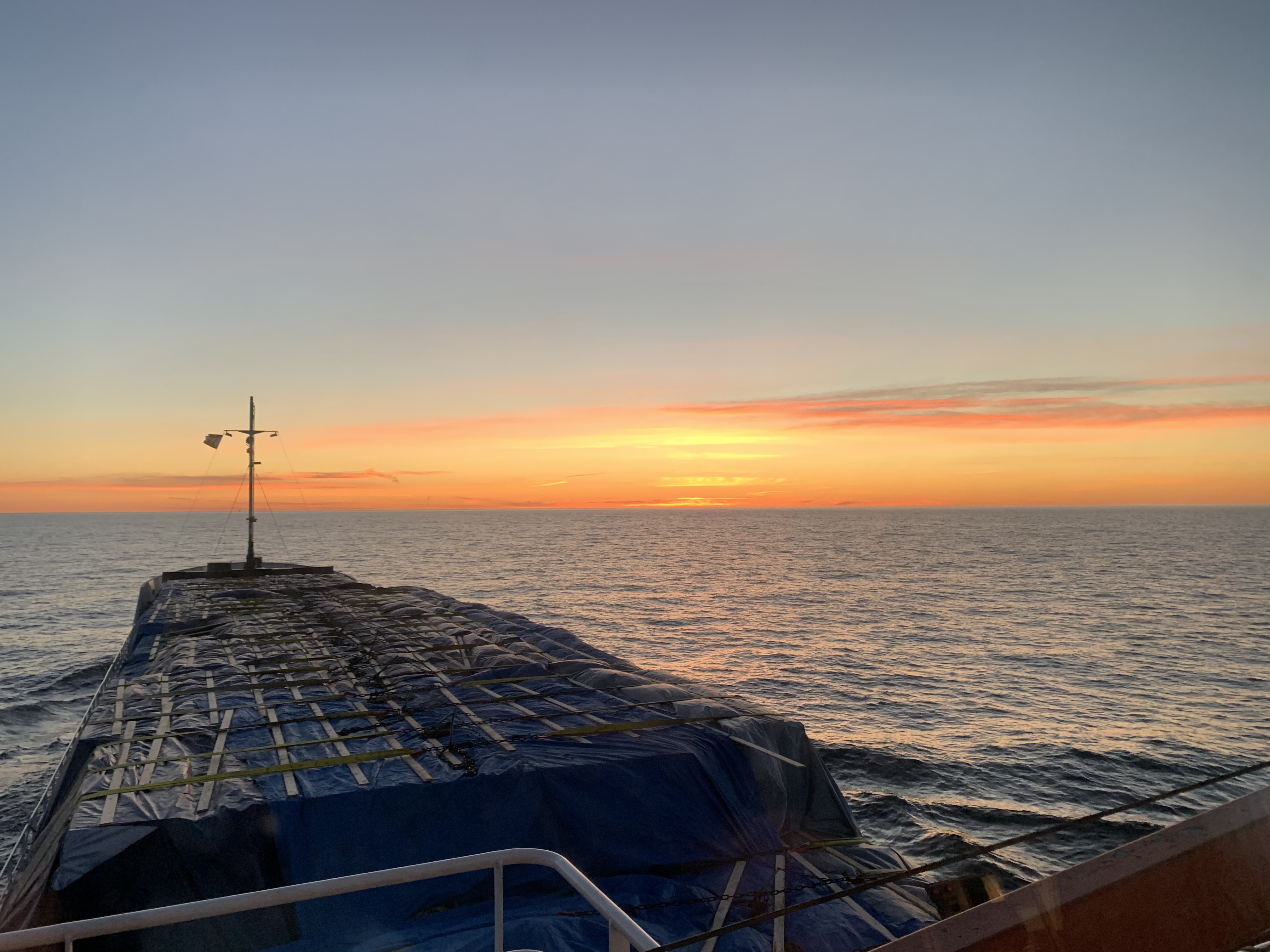
Beautiful sunset underway to Brake with Timber deck cargo

It was a fully efficient and hard working day. It was time for me to get some rest before my night watch at midnight.

We were back on track for a few days sailing before Kiel Channel again and Brake. Would this become our routine for the next voyage? Mhm… we shall see next week!

Take care and have a good rest my friends!

Xxx Sophie

3d Term, Week 5 🤩 ⚓️

15th- 21st of February 2021

Hello! And… another week in Sophie’s adventures onboard Ruyter! Yeah! So as you guessed most probably with my hint from last week, our « promised « Hamina-Brake » trips lasted for 1 trip for now! We were indeed sent to Sluiskil to load fertilizer to Riga! For a change! Maybe from Riga, we would be going back to Hamina…. Hopefully. I honestly kind of liked that all icy timber loadings and…. Not that I am getting « hooked » to it yet, I like to have a cold and freezing winter and a nice and warm summer. So that our trips differ from summer to winter. Indeed. As we are sailing in the same waters all year long, I like to have a few differences in the scenery. It makes a known place look oh so different when it is cold and covered in ice and snow, or when it is all green and sunny glasses are required…. Do you follow what I mean?

Discharging timber cargo in Brake, Germany

Or maybe it was the idea of having to clean the cargo hold again after fertilizer. And let’s admit it. With timber you only need a good sweep because it is clean cargo, and washing the hold in winter is a hell of a lot of work because it doesn’t dry as fast as in the summer: you really need to use the squiggly very well, and mop the tank top as good as you can so that hopefully with the air dryer it will all be ready for hold inspection in the next harbour.

Ruyter alongside in Brake, Germany

But it is ok. Fertilizer it is. Washing the cargo hold is fun, and is also part of the job. At least it is not paperwork…. Although I do not really mind paperwork.

Ok so here we are on a busy busy Monday in Brake: finishing the discharge of the timber, cleaning the hold and preparing it for the next cargo (angle tarpaulins to prevent the cargo to come behind the bulkheads, giving it a good wash for the inspectors and closing everything (speed locks and wedges) for the ultrasonic test we would get.

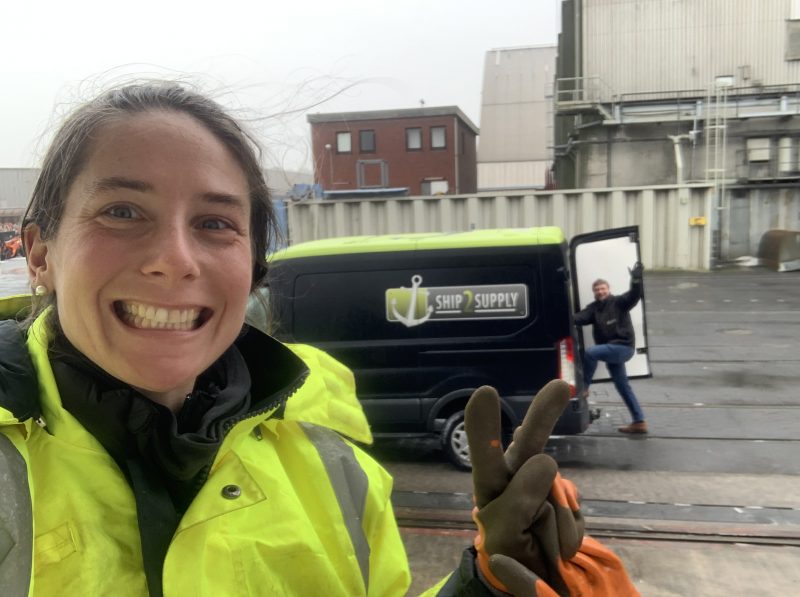
Oh and of course, as it usually happens when we are close to The Netherlands: food delivery! We get our food and ship provisions from Ship2supply in Delfzijl and after a few years we got to know them well and it is always a pleasure to see their truck parking close by to our gangway… ok ok. Not only for the good food, fresh fruits and vegetables we are getting on board but mainly for the crate of cookies! Haha joking. It is always nice to see familiar faces coming on board.

Always happy to see our friends from Ship2Supply!

I was very glad we had our good walk the day before because Monday was quite rainy: happy we were discharging timber, so not a weather-sensitive cargo! It seemed that the rain kept following us for the next days after that.

On the north sea all the way to Sluiskil, where we had to wait a few days alongside without being able to load due to «conjecture»…. Because of the rain of course. Everything seems to stop with rain. I can understand but yeah. A bit frustrating, also when you cannot go ashore. But that is the way it is.

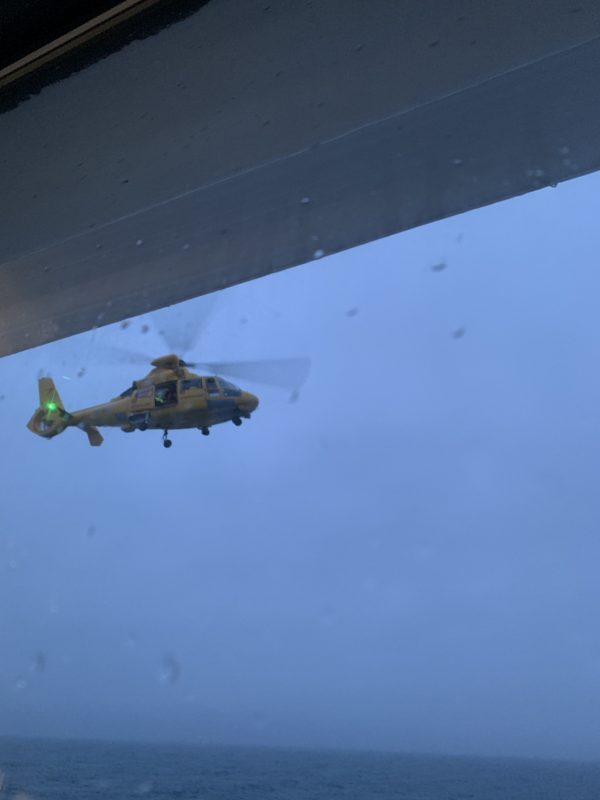
On our way south in the north sea; it was pretty cool: during dinner (why does everything tend to happen during dinner or coffee breaks right?), I had a helicopter call on VHF 16. It often happens that they want to practice boarding a ship so they call us to ask permission to train on our ship. Up to now, I have never had a captain saying he didn’t allow it which is quite cool. It feels like «something is happening onboard» when they are there.

Helicopter drill in the North Sea!

I like helicopters in general. Also on land, if there is a military show with helicopters, tankers and all sorts of cool stuff, I am always one of the first ones asking if I can have a look inside and If I can sit in the pilot’s chair…. Are you not? I always think that what is unusual and not so common can be fun and interesting.

So there was the helicopter drill onboard the ship. Finally a bit of « cooler » on this grey and wet winter day. It was almost dark outside and quite windy too so I suppose it must have been good training for them!

After rain always comes the sun… sunsets at sea!

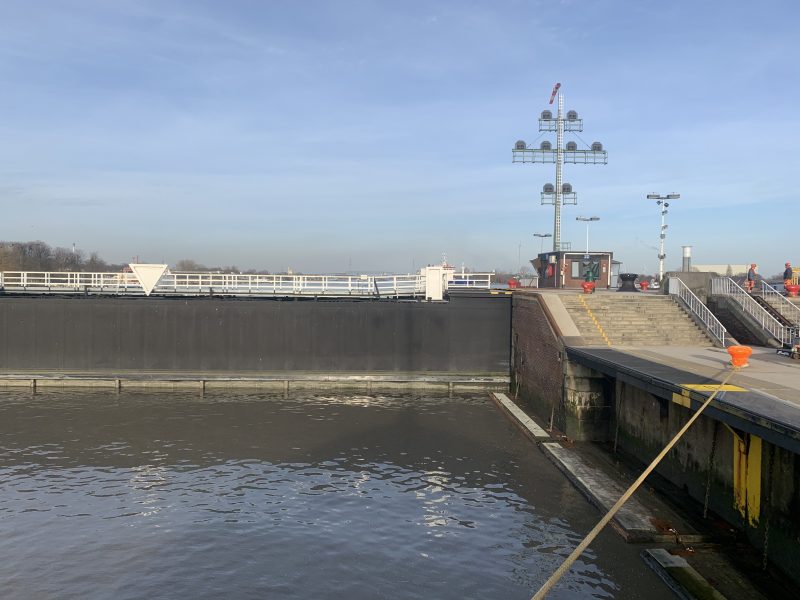
Passing the locks in Terneuzen, weren’t alongside directly after the locks on the waiting berth to have the hold inspection done: Ultrasound test, an inspection of the hold and the bilge. All good. As usual.

Ballasting at the waiting berth in Terneuzen!

They say the hold surveyors from the yard are tough ones and that they are always picky. I have had only once some discussions with some about our rubbers and a speed lock they found was not tight enough for them… ( really?) All the other times it went smoothly. But I still sometimes have that knot in the stomach thinking: will it also pass this time? And it does. I should not worry. I am a Sophie so I do: in my opinion, if it doesn’t pass it is because I was not precise enough in my job and in cleaning and supervision the end result …

The Yara surveyors preparing for the Ultra sonic test on board
This device stays in the hold during the Ultra Sonic test.

They also say that they will be less picky if they have a lot of ships waiting and conjecture; and pickier if their cargo is not ready…. That is the game in shipping: trying to win time for who will be paying what in the end. If they say the ship is not ready and the hold was not accepted, then the ship cannot issue the notice of readiness and the timer doesn’t start…. Do you get it?

The way an ultrasound works is by having all the hatches closed, speed locks on and wedges too. One of the surveyors put a box in the middle of the hold and another one goes around all the hatches with a headset and a tool that looks like an antenna. This way they measure by the number of frequencies passing through the rubbers if there is a « leak » or not. If they aren’t any leaks: all good; if some are found then we need to fix them. simple. 

As soon as the ship that was still in our berth left, we shifted to the Zijkanal C where we would be loading. Luckily we did not have to wait as long as predicting and that same evening we started loading; hatches by hatches has it was still quite grey and cloudy outside…

Ruyter alongside at the Yara terminal in Sluiskil.

It is important to keep in mind the time that it takes you to open or close the hatches; the loading process: if it is by truck, by belt, by crane because this means you cannot decide directly if you want to close the hatches, you might need to wait until the belt is empty which can take a few minutes sometimes…. The cranes are usually the easiest in case of bad weather because they go grab by grab and you can pass in-between and start closing in some places where the hatch cover crane is for example. And the other thing you need to be very aware of is your trim: you cannot use the hatch cover crane in all situations. If your trim is too big it can become very dangerous to drive and let’s say there is slippery cargo on the rails…. It doesn’t help at all.

Loading Fertiliser in Sluiskil, with only one hatch open.

The even hatches at the top hatches, the uneven ones at the bottom hatches. This means that we cannot open the bottom hatches before the top ones. For cargo operations, this implies that we can have either 1 hatch open or 3 in case of bad weather, but not « just two »….( except for hatches 1 and 2 and hatches 8 and 9 😉 )

Sometimes the equipment they use for loading can handle with just one hatch open: very handy like that we do not have to stop all the time, and it is opened and closed way faster. We are there to load right? 

I always find it interesting to see different points of view of the ship…

This time they had a pipe that could turn around quite well so with only one hatch open we could reach under half of the other two hatches next to the open one. And the rate was also fast so it is nice too. You do not have the impression that nothing is happening!

Less than 24 hours later we were out at sea again: through the locks in Terneuzen and off with the pilot in front of Flushing and out in the North Sea. Great! I like it when it managed to stay dry just the time we need to load. The harbour because touch and go. I like being long at sea; I like also being a few days in harbour, but only when we can go sightseeing and for a walk so…. This time we couldn’t better sail again! Haha

A little over 24hours we were already at the locks in Brunsbüttel. Again a bit of luck to have currents with and some easy times for the locks and pilot changes on the channel. Usually, it is always in the middle of the night and some always have to stay longer for the locks or have to come up earlier for the pilot change. It rarely happens that it is similar to our watch system… but yeah we have to go through anyways right?

In the locks in Brunsbüttel, before entering the Kiel Channel

And finally, finally, we got our routine schedule back sailing all the way to Riga fully loaded with fertilizer.

Sometimes I wonder…. Yara is Finnish, but there is also fertilizer in Russia or almost every harbour in Finland…. Why bring it all the way from The Netherlands? I mean I know they are not all the same fertilizers…. But I find it strange sometimes that cargo goes back and forth… imagine how pointless it would be to bring back and forth the same cargo right? I say that, but I am certain it actually does happen with steel coils or wood or wood pulp too! I wouldn’t be surprised!

Underway to Riga…

But okay… I am not sure and I think I would rather not know. It would make my job a bit pointless.

I am glad we could finally catch up on some sleep and some rest with these few easy sailing days. Because after Riga we would probably go back for the timber (so hard work with lashing again) or have short icy trips in the baltic…. We do not know yet!

Let’s dream of another easy sailing trip…. And I will see you next week!

Checking the drafts in Sluiskil: always with a smile of course!

Ciao ciao!!

Sophie xxx

3d term, Week 4 🤩 ⚓️

8th-14th of February 2021

We started the week ready to load timber. As I said. First-time timber so I was a bit curious and anxious. But to be honest, the idea is quite « easy »: it is to have the cargo hold as full as possible, as packed as possible with the least “empty space” in the hold, then the more cubics you will be able to take on deck. 

Now… for the less easy part. All packages do not have the same size. That is the difficult part because of course, they do not all come ” by size” they come out of the shed in what I would think is a total disorganized way. 

And did I mention also that the stability of the ship with timber has to be very very well anticipated and calculated to avoid the disaster of capsizing?… you should never underestimate the weight of the cargo you store on deck: it can get wet and the wood absorbs the extra humidity and therefore weighs more! You also have to be aware of the snow and ice. yeah. Told you … the «idea» is simple and easy but the reality demands quite some « on top of it » matter…

There is a bit of preparation to do before loading timber. Besides opening the hatches, we have to take all the hundreds of slings out of the forecastle where they are stored; but also all the tarpaulines, the heavy hooks and chains…. We have everything ready for the crane to take them ashore in the morning for the shore team to use. We take everything out with the hatch crane and the winch we have on the foremast.

All slings ready on the hatches, to be piucked up my the crane for the shore team.

The crane driver, together with a stevedore on the ship work together for getting the most of it. My job is to make sure they follow the loading plan accordingly so that I can empty my ballast tanks following a plan, but also to make sure they do their job correctly in avoiding big gaps and unwanted lost space, or extra unwanted layers of snow on top of the cargo because it takes space then melts. Once I see that they do it correctly I go and do some other maintenance jobs or administration, always keeping in mind that the cargo operation goes prior to any other job I might want to do. It is highly important to keep the ship safe and keep an eye on the trim so that I can close the hatches at any time and that I simply know what is happening at all times. The idea is that they are loading, of course, so I cannot ask them to discharge and load again. If I see something wrong, I should say it immediately otherwise it is too late. Eventually, I can ask them to “fix” things and tell them I am not so happy and that they have to do better.

Loading timber with 2 cranes.

The nice thing about timber cargo is that it is not dirty cargo. It is not dusty, not sticky. On the opposite, it really smells fresh like the woods! Also, because it is timber, it does not matter if it is raining or snowing. The packages are sort of protected by plastic wrapping you only have to watch out that they take off all the snow on the top of the packs before they put another tier. Snow takes place and it will eventually melt. So it creates a loss of space. 

In Finland, there is one hour difference between the ship. So it is a very early wake-up. When it is cold and frozen, everything seems somehow slower: it takes me more time to open hatches and my finger does not follow as fast… Or probably the hydraulic oil of the hatch crane is just not totally warmed up either! Anyhow it is early. At 4am, I usually head towards my bunk and not on deck! But I have my routine once the hatches are open I either speak with the foreman or I quickly make myself a nice cup of coffee in the bridge. Usually, I have coffee just after because even if I am on time in the morning, I want to make sure there is no problem with the opening of the hatches. Sometimes the shore team is not there yet and is not ready, but at least I am.

The loading went very smoothly: with two cranes it is indeed quite fast. Once the cargo hold is full, that is when the tricky part starts. We close the hatches, speed locks and wedges, and while the deck crew prepares all the side tarpaulins, we take the drafts to make sure to calculate how much cargo we can take on deck. We will for sure have some ballast with timber, for stability. This is where most accidents happen with ships carrying timber cargo. The IMO has a whole recommendation book about it! Ships need to be certified to carry it.

The aft crane and the shore team in Hamina

Another thing with cargo timber… Is the lashing as I mentionned in the beginning of this story. Oh-my-god! There are the tarpaulins (glad that we have the light version:), the slings (single and double) the chains the hooks the side slings, the shackles, the timber for on top of the tarpaulins, the chain blocks to tighten the chains… Well… All his equipment is very heavy. And this is not a 2-hour job. The whole crew is on deck working. Even the Captain! (Well Captain H. is anyways always on deck!) but the cook too! It is a hard job, but fun, because we make it fun, of course. In the end, we are really tired, hungry too, but happy to go to bed. I am really glad that despite the cold, we did not have wind or snow or ice falling from the sky. This would have made this job extremely difficult and terrible. We got it finally done and I must say my poor muscles were already aching from having to store everything back three days later. We were told we would be doing a few runs between Finland and Brake (Germany) with timber… I better get used to it fast right? Good that it is not a weather-sensitive cargo: it can be loaded during rain. Indeed, it is stored outside on the quays in Finland so… no changes when we load. But luckily we were not disturbed by any rain that week. It was indeed quite nice weather: no wind, no snow, no ice droplets…. Cold – very cold! – but clear. I wouldn’t imagine being outside in a snowstorm during loading and lashing! When you have to take off your gloves to make tiny knots with the tarpaulins protecting the cargo…. Brr…

The deck lashing requires tarpaulins to protect a minimum from water so that the timber stays as dry as possible ( as I said earlier, it avoids extra unwanted water/ ice weight on deck), then we have a few timbers positioned on top of the tarpaulins, this prevents the wind from blowing in them. Then we have a lot of very big and long slings on each portside and starboard side that is fixed from the side of the coamings ( so directly to the ship’s structure) and brought on top of the cargo. These two slings are joined by two chains fixed and tightened by a locking hook. Trust me all these equipment are heavy (as much as heavy duty!) and you have to bring them around the deck back and forth and manipulate them. It takes hours to put everything in position and to fix and tighten everything. By the end of the lashing, your muscles are literally burning, and you cannot wait to go directly to bed. Well, at least that is what I thought. To fix the hooks and chains you need a small chain block; that tool is also heavy. In the first step of the procedure, you tighten it as much as possible by hand then with the chain which goes way faster. You always need two persons to do that as it requires some strength to hold the hooks in a good position and direction. Besides the thousands of steps and sweat in your back, you are also going up and down climbing on the cargo. Trust me, when I say it was a great workout, it really was. But imagine doing that in the winter with a few layers of warm clothing and winter overall…. You sometimes feel as Bibendum working his way through the ship…. Again, I am glad we had good weather and that we only had to fight the cold…. Suddenly the -17°C did not feel as cold anymore!

Short coffee brake before proceeding with the lashing on deck!

This was for most of the crew a first in timber deck cargo, for others, it had been years, so the lashing took quite some time, but we ended up finding our way through and getting better at it. I can imagine that if you do this every second week, it goes faster and faster because you end up finding tips and tricks to make your life easier. I was surprised and happy that we worked really well as a crew then to « just get it done » and do the work. I like teamwork. It reminds me of my times on the tall ships: if you didn’t pull on a line as a team, you would never get that sail high enough or sheeted in enough…. It’s all timing and working together to keep up the efficiency.

Ok, so there we were ready to leave Hamina – finally – and sadly (I started to enjoy the cold and the icy view here!) for Brake in Germany. I first got a bit tired of all the work it would request us but thought it was fine, that we just had to go for it. It is funny how your mind gets a bit troubled, or one-sided when colleagues of your say stuff as «  oh so much lashing work for only 3 days sailing », ” it is so much work is not worth it”, “it is not nice”, blah blah blah… well; once you have that in mind, it is hard to get it out. I just thought « ok this is a first let’s give it a try and we will see » right? Although my sore muscles were telling me I didn’t like it at all, I tried very hard to fight my « devil brains » haha.

Departure late afternoon from Hamina

Ok, we are underway. Baltic Sea, Kiel Channel, North Sea and direction brake. It seemed colder there than in Finland actually… But it was only -5°C! Leaving Hamina was quite nice: at 17:00 it was already dark outside of the course and it was still icy. I really enjoyed the view. It seems that I am getting used to the ice and the freezing temperatures up here! We sailed to the Kiel Channel and most of the ice melted on deck as we were getting closer to the 0°C. The stability of the ship was very low which means that we were rolling like babies in our bunks. The total opposite of steel coils! The Kiel Channel was nice: peaceful. I had the second part and the second lock in Brunsbüttel: still cold but sunny weather: perfect to start ( or end in my case ) my day!

I would head to bed to be ready for mooring in Brake. The next morning early was beautiful! The river was amazing when the sun started rising because there was a lot of fog: probably the difference between the air and water temperatures! I really enjoy these small peaceful moments! The nice thing is that we arrived on a weekend and they were not discharging on Sundays! So there it was: my happiness of a Sunday in the harbour where we were allowed to go ashore too! A Sunday with a long walk, just to smoothen out the muscles, get the legs walking for over 100 meters in a row: perfect.

Foggy but beautiful sunrise in Brake
Early morning discharging in Brake

Brake was quite an interesting little city. Captain H, duschi the dog and I went for the grand tour through the city, then on the riversides. Lovely weather, nice architecture, nice company, good talks. I even got « upgraded » by the dog! Indeed she usually really hates me, except when I give her some pieces of my orange or when there are rough seas. But then this happened: I had to enter a hotel to ask if I could use their bathroom ( after over 2 hours walking… yes yes) and apparently Duschi was staring at the door and whining waiting for me! And when I came out she seemed all happy and captain H. said she had been waiting for me as if I was « part of her group » now…. Well not so fast Sophie. Remember it is still Duschi, the dog that hates other women because she is always so jealous that then talk to her property-master-owner-king-captain or whatever you name it. But it felt nice to be finally accepted by the dog – for that day! 

We returned to the ship and had a good evening: the discharging would proceed early the next day and I would have to wake up very early again to open hatches…. So better get some more sleep and rest again!

Always ready on the foredeck!

See you next week! Will we be going as planned to Hamina again? Suspense suspense… I shall not say more!

Take care, my friends!

Xxx Sophie