3d Term, Week 6 🤩⚓️

22nd – 28th of February 2021

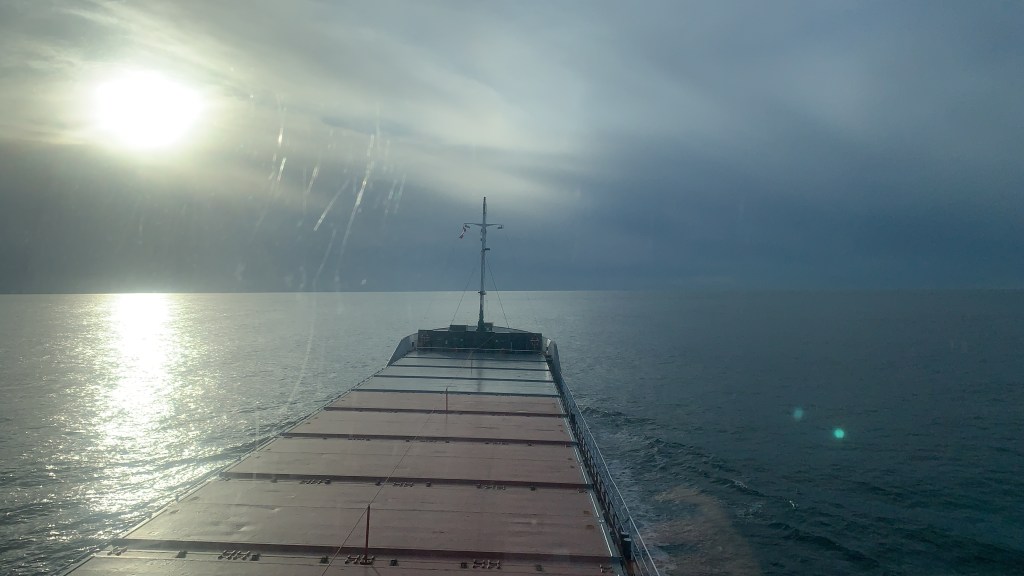
Riga!!!! Discharging the nice fertilizer loaded in Sluiskil! After a couple of days sailing in the Baltic, we arrived in Riga. It was an interesting trip for me because when entering the Gulf of Riga, we were regularly checking the ice maps for the ice situation. And it seem it was all clear for us till Riga, which was good. Maybe a bit more ice close to the coast. But then this happened: During my night watch, I found it strange that a ship ahead of me suddenly slowed down and almost stopped. That vessel was of course quite a few miles ahead of me, and there were also other vessels behind me and we had probably all checked the same ice charts that evening but….. As I saw the vessel strongly slowing down and only doing 2-3 knots of speed; I paid a little more attention to the horizon to try and figure out what was happening. Indeed, my route was not too far from hers so I didn’t want to be on a collision course with her but wanted to leave enough space in case she had some troubles and was drifting. But suddenly on the horizon, I could distinguish in the deep night so blurry greyish cover on the horizon. And there was a huge ice patch there and it was not mentioned on the ice charts!

Perfect conditions for discharging in Riga
The quayside in Riga still full of snow
Ruyter alongside in Riga, discharging fertilizer, the fog came up.

We did not have much choice to go through, but luckily Ruyter is an Ice class A vessel so she handles it well. Of course, the inevitable noise of ice scratching the hull surprised quite a few that night. Normal: they had expected a peaceful non-icy night and they suddenly felt as if we were stuck in ice again. Almost. I mean. It was a surprise for us. And also for the other vessels. The one ahead of us and… the ones behind us! The only thing you have to do is slow down the ship and enter slowly to not have any unwanted damages. Because of the ship ahead we knew the patch was not that big; but big enough to last a couple of hours pushing away the patch. It reminded me of when we would go on unchartered areas in Antarctica on board Bark Europa… slowly pushing and making sure everything was fine. Well; that happened and it was fun. It was my little story of the night, haha and I shall remember it well! « The unchartered big patch of ice in the Gulf of Riga ».

So there we were back in ice in the harbour. A nice blue sky the morning, all hatches open, but nice and fresh (read cold haha…) air outside. Good. I do not mind the cold anymore, right? All these cold showers are supposed to toughen me up, and after my experience at -17° in Finland… any temperature around the 0° should be warm too, is that not correct? There was also still snow on the quaysides! Amazing! It is funny how in these last posts, I have the feeling I have been only talking about timber cargo, ice and snow. But to be honest it is probably the only thing we talk about onboard: how cold it is going to be outside for cargo and mooring operations and what we have to do on deck for the lashings! Haha. Oh well.

the view from the porthole in my cabin

I was saying that the day started with a great blue sky so I opened up all hatches for discharging. But later during the day, it started to become foggy. I do not really like it when it is foggy because I never know what to expect. I know that in theory there is no rain with fog, but to my eyes, fog is only damp air; thus wet air and it is not that I get nervous with sensitive cargo, but I do find myself checking outside way more often than with blue sky. Fertilizer dissolves very fast with water, and would not want to have it on my hands that the cargo gets damaged because of me. Luckily it did not happen and we were discharged very smoothly.

Underway to Hamina , following the icebreaker

From Riga, we sailed in ballast to Hamina again to do our second timber voyage to Brake. Unlike Riga, Hamina was still completely covered in ice. There was so much ice that we actually got stuck in the ice! Yes yes! We tried pushing a bit but we were not going anywhere really. And if the pushing method works for smaller and already a bit broken ice; it doesn’t work at all for big thick unbroken patches. We had to call the ice breaker. Captain H. Called them and as they were not too far from us, they came directly to « rescue » us. I mean it is not a rescue in the literal sense; they are there to assist us. And that is what they did! They flew in to help us and passed next to us quite close to break the ice and create a waterway for us. It seems for them that it was normal sailing: no ice no nothing. Can you imagine the power they have? As you cannot move forward they just sail close by to help you out and create a gap so that you can sail through? It was pretty cool to see! We had to be fast to captain H. Directly followed him because otherwise the ice just closes back behind the ice-breaker and we are stuck again. We could almost sail our normal speed again….

Sailing in the ice
The bulb passing the ice when sailing

And we loaded in the same conditions as two weeks ago. Except that this time we did not have a full weekend waiting in the harbour. Oh and also the weather was not as nice with big sun and blue skies. We loaded directly the day after we arrived. This time I was more at ease. More at ease because I knew the cargo, I knew the plan as I had already seen it in action once and simply because I knew what was expected. As simple as that.

Alongside in Hamina, Finland

The sun of course only came out as we were sailing out of the harbour. I would not say it often happens like that but… yeah. The good thing about sailing in winter, compared to autumn for example; is that there are more high-pressure systems so the majority of the time it is blue skies and correct winds. While in autumn it can be horrible weather with very strong winds and depressions passing over the Baltic Sea one after the other. And that is very tiring.

Loading timber in Hamina

This time what was tiring was the lashing of the deck cargo; once again. But not the weather. As it was the second time we were doing it, we managed to get in a good rhythm and found a few tricks to make our lives easier. Working with the watch crane a bit more to lift the heavy parts for example. But it seems that there is no way to end up not making so many steps and back and forth to carry the slings and hooks and chains from one part to another of the ship. Unless having to storages, one fore and one aft; but it is not the case. We just put our « just do it » mentality on and… just did it; calmly but well. It is very important to double-check the lashing on deck because if it is not tight enough, cargo can fall and it becomes a big problem for the stability of the ship.

Departing Hamina in icy water

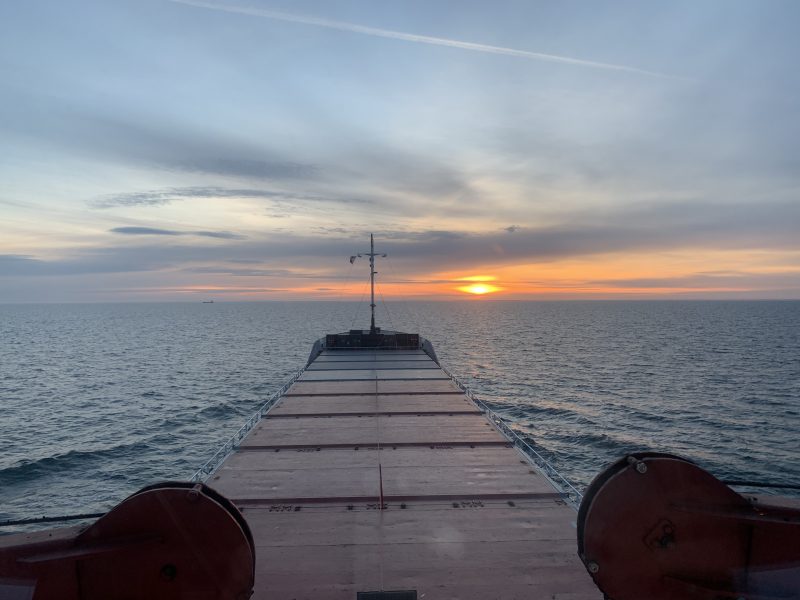
The lashing took place during the daytime and we easily sailed out in the middle of the afternoon for Brake. We managed to have a beautiful sunset too. I admit I do not get tired of sunsets at sea. I have a lot of pictures of them. When I see one I take a picture. It is always the same but different. Different colours, different clouds; but always as beautiful as the previous one.
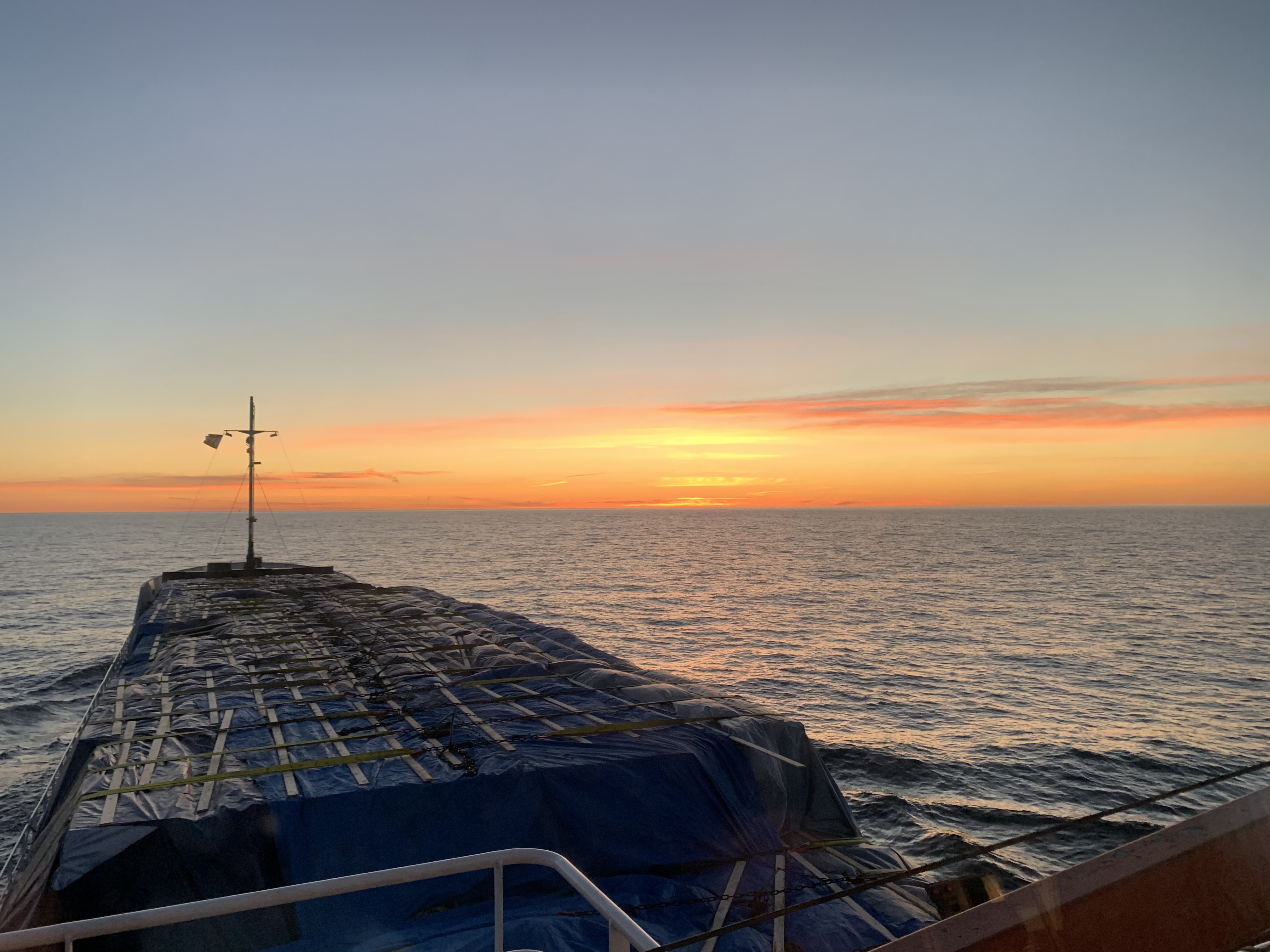
Beautiful sunset underway to Brake with Timber deck cargo

It was a fully efficient and hard working day. It was time for me to get some rest before my night watch at midnight.

We were back on track for a few days sailing before Kiel Channel again and Brake. Would this become our routine for the next voyage? Mhm… we shall see next week!

Take care and have a good rest my friends!

Xxx Sophie

3d Term, Week 5 🤩 ⚓️

15th- 21st of February 2021

Hello! And… another week in Sophie’s adventures onboard Ruyter! Yeah! So as you guessed most probably with my hint from last week, our « promised « Hamina-Brake » trips lasted for 1 trip for now! We were indeed sent to Sluiskil to load fertilizer to Riga! For a change! Maybe from Riga, we would be going back to Hamina…. Hopefully. I honestly kind of liked that all icy timber loadings and…. Not that I am getting « hooked » to it yet, I like to have a cold and freezing winter and a nice and warm summer. So that our trips differ from summer to winter. Indeed. As we are sailing in the same waters all year long, I like to have a few differences in the scenery. It makes a known place look oh so different when it is cold and covered in ice and snow, or when it is all green and sunny glasses are required…. Do you follow what I mean?

Discharging timber cargo in Brake, Germany

Or maybe it was the idea of having to clean the cargo hold again after fertilizer. And let’s admit it. With timber you only need a good sweep because it is clean cargo, and washing the hold in winter is a hell of a lot of work because it doesn’t dry as fast as in the summer: you really need to use the squiggly very well, and mop the tank top as good as you can so that hopefully with the air dryer it will all be ready for hold inspection in the next harbour.

Ruyter alongside in Brake, Germany

But it is ok. Fertilizer it is. Washing the cargo hold is fun, and is also part of the job. At least it is not paperwork…. Although I do not really mind paperwork.

Ok so here we are on a busy busy Monday in Brake: finishing the discharge of the timber, cleaning the hold and preparing it for the next cargo (angle tarpaulins to prevent the cargo to come behind the bulkheads, giving it a good wash for the inspectors and closing everything (speed locks and wedges) for the ultrasonic test we would get.

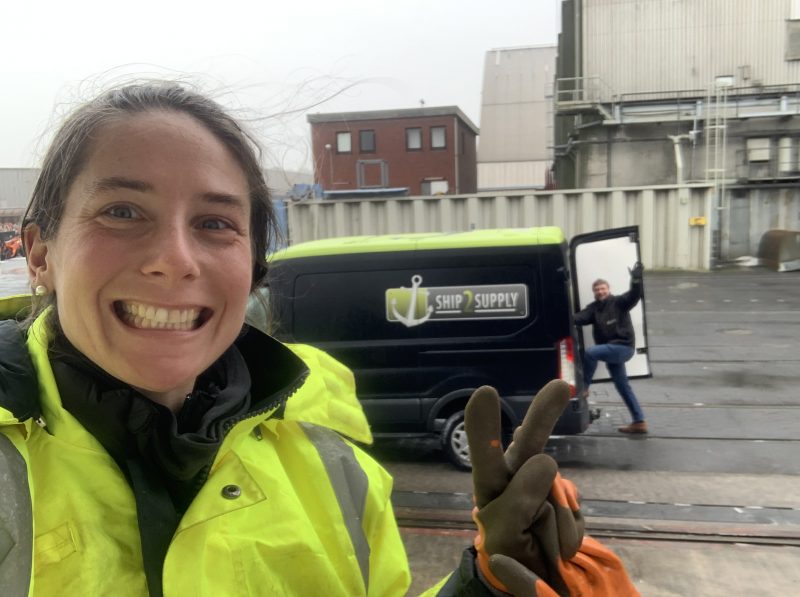
Oh and of course, as it usually happens when we are close to The Netherlands: food delivery! We get our food and ship provisions from Ship2supply in Delfzijl and after a few years we got to know them well and it is always a pleasure to see their truck parking close by to our gangway… ok ok. Not only for the good food, fresh fruits and vegetables we are getting on board but mainly for the crate of cookies! Haha joking. It is always nice to see familiar faces coming on board.

Always happy to see our friends from Ship2Supply!

I was very glad we had our good walk the day before because Monday was quite rainy: happy we were discharging timber, so not a weather-sensitive cargo! It seemed that the rain kept following us for the next days after that.

On the north sea all the way to Sluiskil, where we had to wait a few days alongside without being able to load due to «conjecture»…. Because of the rain of course. Everything seems to stop with rain. I can understand but yeah. A bit frustrating, also when you cannot go ashore. But that is the way it is.

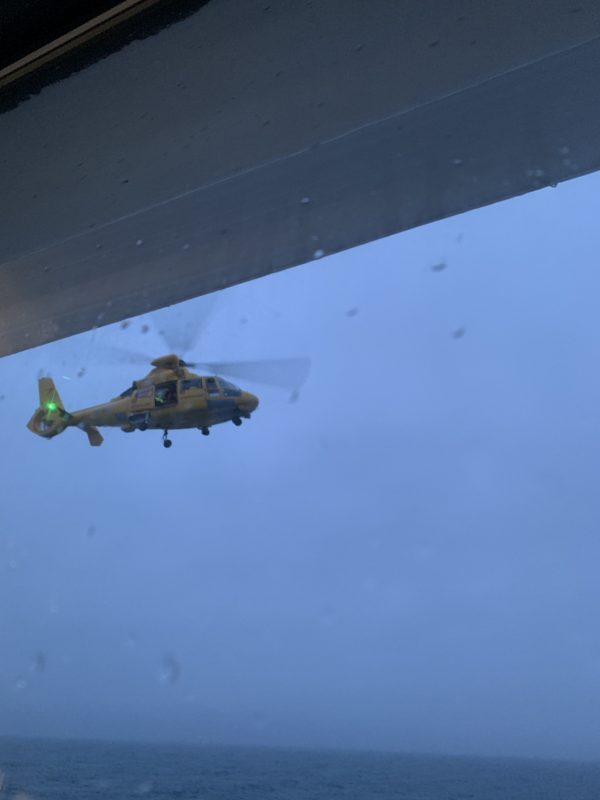
On our way south in the north sea; it was pretty cool: during dinner (why does everything tend to happen during dinner or coffee breaks right?), I had a helicopter call on VHF 16. It often happens that they want to practice boarding a ship so they call us to ask permission to train on our ship. Up to now, I have never had a captain saying he didn’t allow it which is quite cool. It feels like «something is happening onboard» when they are there.

Helicopter drill in the North Sea!

I like helicopters in general. Also on land, if there is a military show with helicopters, tankers and all sorts of cool stuff, I am always one of the first ones asking if I can have a look inside and If I can sit in the pilot’s chair…. Are you not? I always think that what is unusual and not so common can be fun and interesting.

So there was the helicopter drill onboard the ship. Finally a bit of « cooler » on this grey and wet winter day. It was almost dark outside and quite windy too so I suppose it must have been good training for them!

After rain always comes the sun… sunsets at sea!

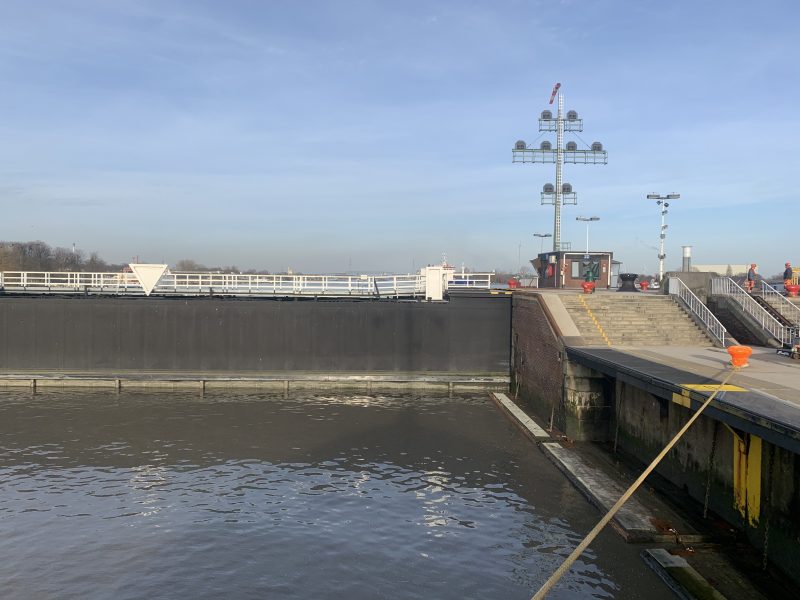
Passing the locks in Terneuzen, weren’t alongside directly after the locks on the waiting berth to have the hold inspection done: Ultrasound test, an inspection of the hold and the bilge. All good. As usual.

Ballasting at the waiting berth in Terneuzen!

They say the hold surveyors from the yard are tough ones and that they are always picky. I have had only once some discussions with some about our rubbers and a speed lock they found was not tight enough for them… ( really?) All the other times it went smoothly. But I still sometimes have that knot in the stomach thinking: will it also pass this time? And it does. I should not worry. I am a Sophie so I do: in my opinion, if it doesn’t pass it is because I was not precise enough in my job and in cleaning and supervision the end result …

The Yara surveyors preparing for the Ultra sonic test on board
This device stays in the hold during the Ultra Sonic test.

They also say that they will be less picky if they have a lot of ships waiting and conjecture; and pickier if their cargo is not ready…. That is the game in shipping: trying to win time for who will be paying what in the end. If they say the ship is not ready and the hold was not accepted, then the ship cannot issue the notice of readiness and the timer doesn’t start…. Do you get it?

The way an ultrasound works is by having all the hatches closed, speed locks on and wedges too. One of the surveyors put a box in the middle of the hold and another one goes around all the hatches with a headset and a tool that looks like an antenna. This way they measure by the number of frequencies passing through the rubbers if there is a « leak » or not. If they aren’t any leaks: all good; if some are found then we need to fix them. simple. 

As soon as the ship that was still in our berth left, we shifted to the Zijkanal C where we would be loading. Luckily we did not have to wait as long as predicting and that same evening we started loading; hatches by hatches has it was still quite grey and cloudy outside…

Ruyter alongside at the Yara terminal in Sluiskil.

It is important to keep in mind the time that it takes you to open or close the hatches; the loading process: if it is by truck, by belt, by crane because this means you cannot decide directly if you want to close the hatches, you might need to wait until the belt is empty which can take a few minutes sometimes…. The cranes are usually the easiest in case of bad weather because they go grab by grab and you can pass in-between and start closing in some places where the hatch cover crane is for example. And the other thing you need to be very aware of is your trim: you cannot use the hatch cover crane in all situations. If your trim is too big it can become very dangerous to drive and let’s say there is slippery cargo on the rails…. It doesn’t help at all.

Loading Fertiliser in Sluiskil, with only one hatch open.

The even hatches at the top hatches, the uneven ones at the bottom hatches. This means that we cannot open the bottom hatches before the top ones. For cargo operations, this implies that we can have either 1 hatch open or 3 in case of bad weather, but not « just two »….( except for hatches 1 and 2 and hatches 8 and 9 😉 )

Sometimes the equipment they use for loading can handle with just one hatch open: very handy like that we do not have to stop all the time, and it is opened and closed way faster. We are there to load right? 

I always find it interesting to see different points of view of the ship…

This time they had a pipe that could turn around quite well so with only one hatch open we could reach under half of the other two hatches next to the open one. And the rate was also fast so it is nice too. You do not have the impression that nothing is happening!

Less than 24 hours later we were out at sea again: through the locks in Terneuzen and off with the pilot in front of Flushing and out in the North Sea. Great! I like it when it managed to stay dry just the time we need to load. The harbour because touch and go. I like being long at sea; I like also being a few days in harbour, but only when we can go sightseeing and for a walk so…. This time we couldn’t better sail again! Haha

A little over 24hours we were already at the locks in Brunsbüttel. Again a bit of luck to have currents with and some easy times for the locks and pilot changes on the channel. Usually, it is always in the middle of the night and some always have to stay longer for the locks or have to come up earlier for the pilot change. It rarely happens that it is similar to our watch system… but yeah we have to go through anyways right?

In the locks in Brunsbüttel, before entering the Kiel Channel

And finally, finally, we got our routine schedule back sailing all the way to Riga fully loaded with fertilizer.

Sometimes I wonder…. Yara is Finnish, but there is also fertilizer in Russia or almost every harbour in Finland…. Why bring it all the way from The Netherlands? I mean I know they are not all the same fertilizers…. But I find it strange sometimes that cargo goes back and forth… imagine how pointless it would be to bring back and forth the same cargo right? I say that, but I am certain it actually does happen with steel coils or wood or wood pulp too! I wouldn’t be surprised!

Underway to Riga…

But okay… I am not sure and I think I would rather not know. It would make my job a bit pointless.

I am glad we could finally catch up on some sleep and some rest with these few easy sailing days. Because after Riga we would probably go back for the timber (so hard work with lashing again) or have short icy trips in the baltic…. We do not know yet!

Let’s dream of another easy sailing trip…. And I will see you next week!

Checking the drafts in Sluiskil: always with a smile of course!

Ciao ciao!!

Sophie xxx

3d term, Week 2 🤩⚓️

25th-31st of January 2021

So… we arrived in Goole (UK) Sunday but did not go ashore there. We arrived a little earlier and we were hoping to be able to be alongside for the night but they (the authorities) decided otherwise. So we had to stay at anchor in the deepwater area and wake up early early to heave up anchor and get the pilot onboard that would sail with us on the river up to our berth.

On our way to Goole

When these kinds of changes happen, I am usually not called in the morning to heave up the anchor. I usually stay on my normal anchor watch routine or swap with the engineer or captain so that not all of us are exhausted the next morning.

Indeed, as the deck officer, I am responsible for opening the hatches open on time in the morning. So there I was at 6 am ship’s time with all hatches open, ready for discharging while the others could take a wee nap. First thing as soon as discharging starts is ballasting the vessel. I usually really need to be awake and fit then, because times like this are only about “go go go” moments. I start early and finish late. It is quite rare that I get to go back to sleep for a short nap. I just try to keep my mind focused on the job: hatches and weather and not think too much. Usually, it is not a problem. I know I will be able to rest later at sea for example, but sometimes on the spot, it can be quite tough. This time as soon as discharging was done, we had to wash the cargo hold and move bulkheads again. The pilot would come onboard in the middle of the night and we would have a short 2-hour sail up the river to another berth in Goole.

Moored on the Humber River

There, we were supposed to start a new loading in the darling morning. But, as it often happens in the shipping world: change of plan! We would not start the discharge. Only the day after. So we had an easy day that day because we were all quite wrecked from the nights before of course. That is the nice thing when some change of plans happen! And it is nice to know that changes are not always for the bad either. It gave us time to breathe and have a look at the maintenance jobs to be done onboard.

Sunset? Or sunrise? What would you say?

One year ago we had Port state control onboard (PSC): is an official inspection of the ship that can only be done in a foreign country. Your flag state cannot inspect you (unless an annual inspection for example – but not a surprise one let’s say). This inspection is officially recorded on the Paris-MOU website with all the eventual deficiencies that have been found. The deficiencies are available to any person who looks up your vessel. Of course, the worst-case scenario is that the vessel is “chained” or detained and cannot sail out. That usually happens if there are too many deficiencies or important items to be solved. The goal of course is to have the least possible deficiencies which mean that the vessel is well taken care of and is in good condition. Usually, after 1 year, the vessel comes up on the top of the “to be inspected” list and is “due” to re-inspection. This is how we know that we can expect PSC onboard. If the ship is well maintained and in good order – which means: ” if you did your job well”, then there is nothing to be afraid or worry about. It should go just fine. But you never know. If inspectors have had a bad day, it could be that they will be searching for a small thing you never know. And of course, we are humans so sometimes small things can also be forgotten! All this to say that well, we were expecting a PSC inspection anytime soon so I was glad to have that extra calm time to make sure the paperwork was in order but also the deck and its safety equipment.

Well. They didn’t come, and we also didn’t start loading till the afternoon of the next day! haha

Our next cargo was an interesting one! Railways for trains that we would bring to Hamina in Finland!

Railways: an interesting cargo!

I have never transported such cargo. It is in steel and very heavy for a very little volume. This means that most of the weight (centre of gravity) of the cargo would be at the bottom of the ship. I was now just keeping my fingers crossed that we would not get any heavy weather towards Finland because with such cargo, the ship starts rolling a lot and becomes quite “nervous” and it makes sleeping less nice and you sometimes need to hold on to things a little more. Life at sea!

Loadingvtge railways with two cranes

The rails were 50 meters long so I had to open all the hatches to load.

Two cranes were manipulating the rails together to put them in the hold. It seemed like quite a tricky job to do!

The nice thing I am experiencing about this job is that so far I have found it quite diverse regarding destinations and cargo it seems that I am always learning something new on every trip, so that is quite nice. I hope it will stay like that and that I will not get tired of too many of the same trips in the future.

Train railways! Isn’t that cool? The way they made them fast at the end was also interesting. The last layer was fairly lashed with a strap and partly with timber that was hammered in between the rails.

Another nice thing about railways that I discovered, is that I actually find them very photogenic and artistic! Coming from an architecture background – did you know I am an architect and studied the full courses at the university in Paris? It is a big part with these about lines and shapes. I must say I very much enjoy taking “artistic” pictures! or at least I try to call them “artistic”!

Moored in Goole, ready to load steel!

The harbour of Goole is very interesting we were inside the docks and had to pass through a narrow lock, then very narrow spaces with quite a lot of bends to reach either our berthing place or the locks. I was then on the foredeck guiding the captain in his manoeuvre giving him the distances we had ahead of us. I like doing such things because it “spices” up our everyday routine.

Underway from Goole to Hamina of course we sailed again through the Kiel Channel. And again at night making some slight changes in the watches so that they would correspond to the moments we enter the locks in Brunsbüttel and Holtenau. And also for the pilot change that occurs midway through the channel. Despite what other people think, I enjoy the channel, it is usually peaceful and quiet and there is always something different: the weather – sun, rain or fog-, the time of the day people walk, cycle – or not – on the quays. Sometimes the pilots want to steer so we are happy to let them do, sometimes we have to steer all the way through. I do not mind. Well, I also do not have the choice as it is also my job right? Anyways.

All frozen on the foredeck!

Fun fact about the time we passed the locks in Brunsbüttel: I had my first frozen mooring line experience! It was -9°c when we entered the locks and in 1 hour outside, the lines were frozen as sticks. In the freezing areas in the winter, we take time to store all our lines either in the paint-store forward or in the workshop aft so that we do not have that problem when arriving in the harbour and preparing for mooring. I better get used to it as when we look at the ice charts in the Gulf of Finland, it will be cold there!

Always happy, or trying to be of course! 🙂

I am looking forward to some ice experiences of course it reminds me of when I was sailing in Antarctica. Except that I house the feeling that summer in Antarctica was warmer than winter in the Baltic! We will see!

I will let you know next week what happens! 🙂