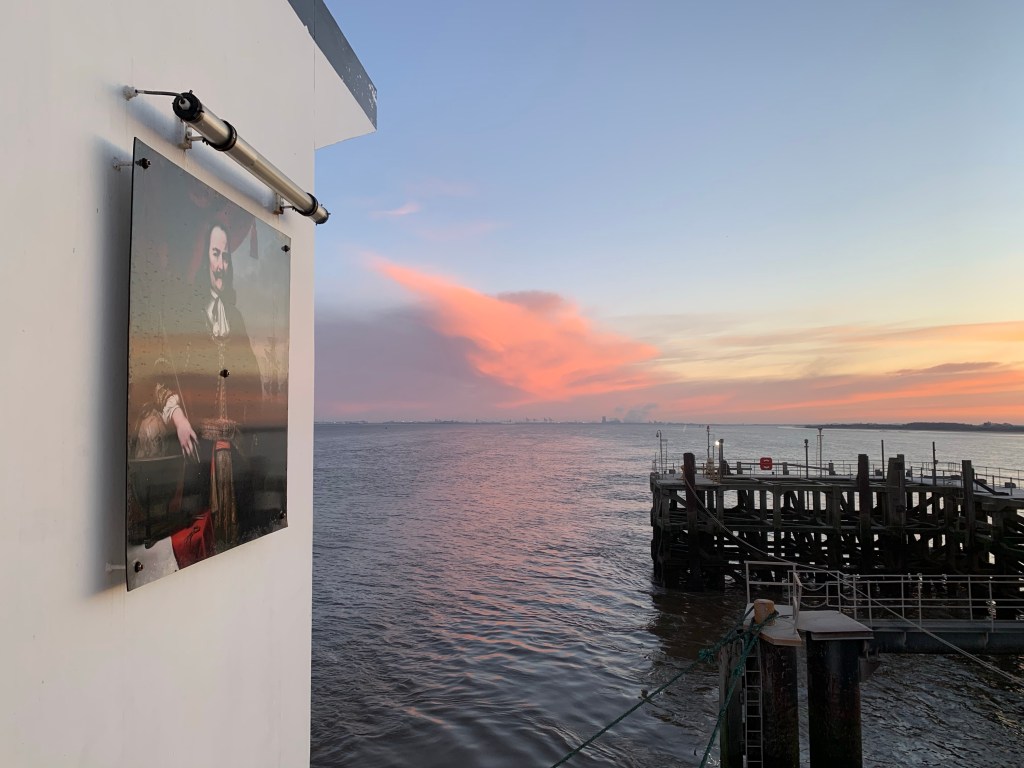
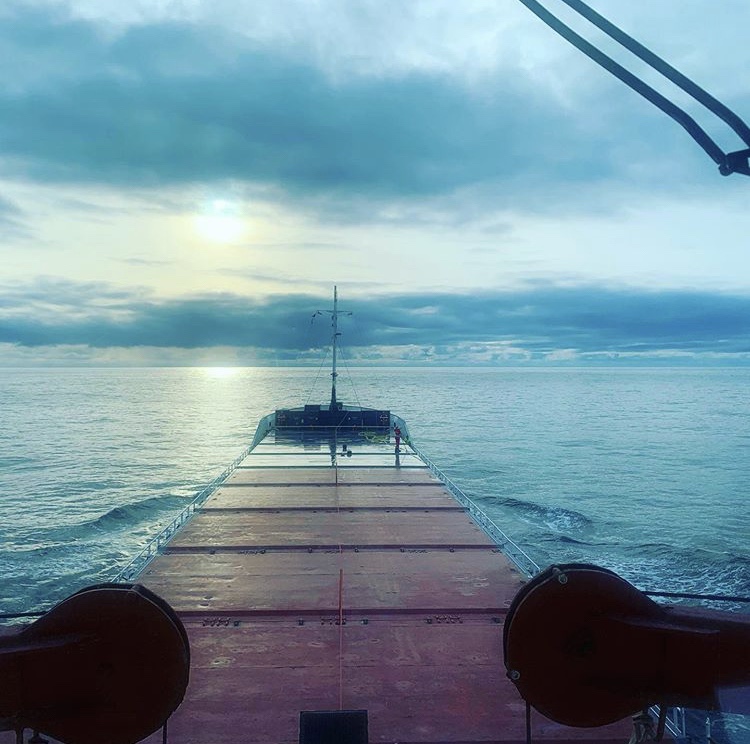
3d Term, Week 6 🤩⚓️

22nd – 28th of February 2021

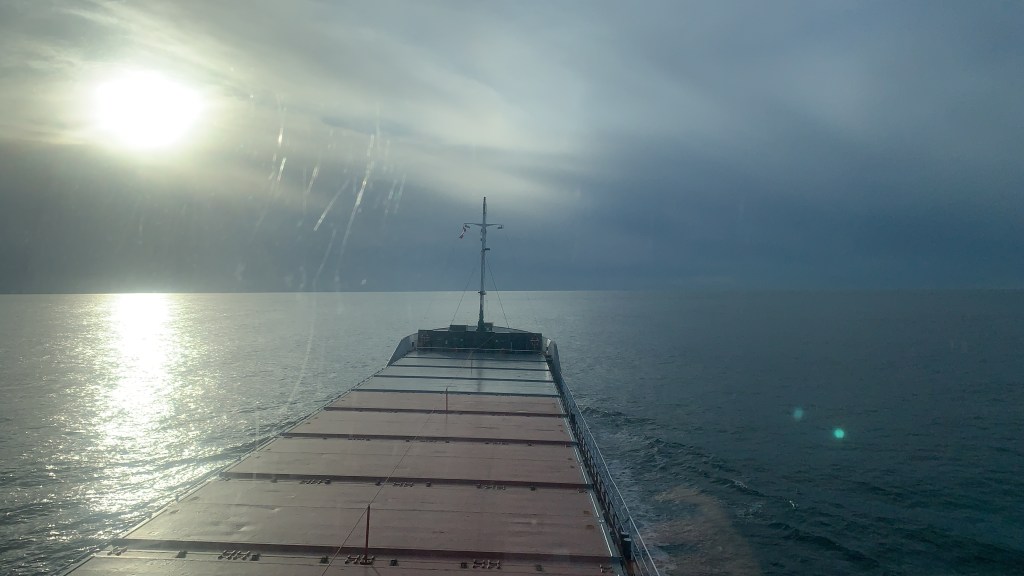
Riga!!!! Discharging the nice fertilizer loaded in Sluiskil! After a couple of days sailing in the Baltic, we arrived in Riga. It was an interesting trip for me because when entering the Gulf of Riga, we were regularly checking the ice maps for the ice situation. And it seem it was all clear for us till Riga, which was good. Maybe a bit more ice close to the coast. But then this happened: During my night watch, I found it strange that a ship ahead of me suddenly slowed down and almost stopped. That vessel was of course quite a few miles ahead of me, and there were also other vessels behind me and we had probably all checked the same ice charts that evening but….. As I saw the vessel strongly slowing down and only doing 2-3 knots of speed; I paid a little more attention to the horizon to try and figure out what was happening. Indeed, my route was not too far from hers so I didn’t want to be on a collision course with her but wanted to leave enough space in case she had some troubles and was drifting. But suddenly on the horizon, I could distinguish in the deep night so blurry greyish cover on the horizon. And there was a huge ice patch there and it was not mentioned on the ice charts!

Perfect conditions for discharging in Riga
The quayside in Riga still full of snow
Ruyter alongside in Riga, discharging fertilizer, the fog came up.

We did not have much choice to go through, but luckily Ruyter is an Ice class A vessel so she handles it well. Of course, the inevitable noise of ice scratching the hull surprised quite a few that night. Normal: they had expected a peaceful non-icy night and they suddenly felt as if we were stuck in ice again. Almost. I mean. It was a surprise for us. And also for the other vessels. The one ahead of us and… the ones behind us! The only thing you have to do is slow down the ship and enter slowly to not have any unwanted damages. Because of the ship ahead we knew the patch was not that big; but big enough to last a couple of hours pushing away the patch. It reminded me of when we would go on unchartered areas in Antarctica on board Bark Europa… slowly pushing and making sure everything was fine. Well; that happened and it was fun. It was my little story of the night, haha and I shall remember it well! « The unchartered big patch of ice in the Gulf of Riga ».

So there we were back in ice in the harbour. A nice blue sky the morning, all hatches open, but nice and fresh (read cold haha…) air outside. Good. I do not mind the cold anymore, right? All these cold showers are supposed to toughen me up, and after my experience at -17° in Finland… any temperature around the 0° should be warm too, is that not correct? There was also still snow on the quaysides! Amazing! It is funny how in these last posts, I have the feeling I have been only talking about timber cargo, ice and snow. But to be honest it is probably the only thing we talk about onboard: how cold it is going to be outside for cargo and mooring operations and what we have to do on deck for the lashings! Haha. Oh well.

the view from the porthole in my cabin

I was saying that the day started with a great blue sky so I opened up all hatches for discharging. But later during the day, it started to become foggy. I do not really like it when it is foggy because I never know what to expect. I know that in theory there is no rain with fog, but to my eyes, fog is only damp air; thus wet air and it is not that I get nervous with sensitive cargo, but I do find myself checking outside way more often than with blue sky. Fertilizer dissolves very fast with water, and would not want to have it on my hands that the cargo gets damaged because of me. Luckily it did not happen and we were discharged very smoothly.

Underway to Hamina , following the icebreaker

From Riga, we sailed in ballast to Hamina again to do our second timber voyage to Brake. Unlike Riga, Hamina was still completely covered in ice. There was so much ice that we actually got stuck in the ice! Yes yes! We tried pushing a bit but we were not going anywhere really. And if the pushing method works for smaller and already a bit broken ice; it doesn’t work at all for big thick unbroken patches. We had to call the ice breaker. Captain H. Called them and as they were not too far from us, they came directly to « rescue » us. I mean it is not a rescue in the literal sense; they are there to assist us. And that is what they did! They flew in to help us and passed next to us quite close to break the ice and create a waterway for us. It seems for them that it was normal sailing: no ice no nothing. Can you imagine the power they have? As you cannot move forward they just sail close by to help you out and create a gap so that you can sail through? It was pretty cool to see! We had to be fast to captain H. Directly followed him because otherwise the ice just closes back behind the ice-breaker and we are stuck again. We could almost sail our normal speed again….

Sailing in the ice
The bulb passing the ice when sailing

And we loaded in the same conditions as two weeks ago. Except that this time we did not have a full weekend waiting in the harbour. Oh and also the weather was not as nice with big sun and blue skies. We loaded directly the day after we arrived. This time I was more at ease. More at ease because I knew the cargo, I knew the plan as I had already seen it in action once and simply because I knew what was expected. As simple as that.

Alongside in Hamina, Finland

The sun of course only came out as we were sailing out of the harbour. I would not say it often happens like that but… yeah. The good thing about sailing in winter, compared to autumn for example; is that there are more high-pressure systems so the majority of the time it is blue skies and correct winds. While in autumn it can be horrible weather with very strong winds and depressions passing over the Baltic Sea one after the other. And that is very tiring.

Loading timber in Hamina

This time what was tiring was the lashing of the deck cargo; once again. But not the weather. As it was the second time we were doing it, we managed to get in a good rhythm and found a few tricks to make our lives easier. Working with the watch crane a bit more to lift the heavy parts for example. But it seems that there is no way to end up not making so many steps and back and forth to carry the slings and hooks and chains from one part to another of the ship. Unless having to storages, one fore and one aft; but it is not the case. We just put our « just do it » mentality on and… just did it; calmly but well. It is very important to double-check the lashing on deck because if it is not tight enough, cargo can fall and it becomes a big problem for the stability of the ship.

Departing Hamina in icy water

The lashing took place during the daytime and we easily sailed out in the middle of the afternoon for Brake. We managed to have a beautiful sunset too. I admit I do not get tired of sunsets at sea. I have a lot of pictures of them. When I see one I take a picture. It is always the same but different. Different colours, different clouds; but always as beautiful as the previous one.
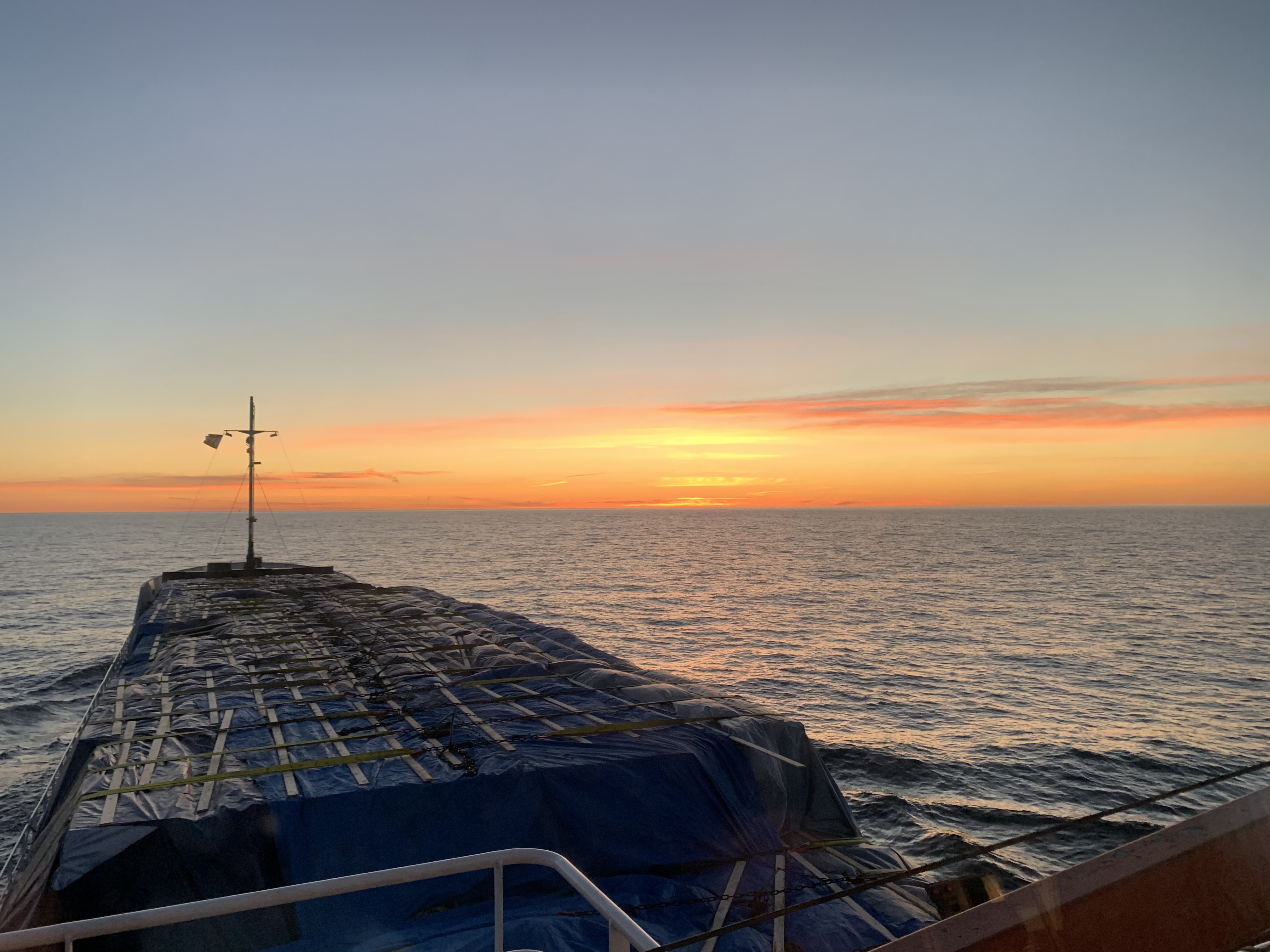
Beautiful sunset underway to Brake with Timber deck cargo

It was a fully efficient and hard working day. It was time for me to get some rest before my night watch at midnight.

We were back on track for a few days sailing before Kiel Channel again and Brake. Would this become our routine for the next voyage? Mhm… we shall see next week!

Take care and have a good rest my friends!

Xxx Sophie
3d term, Week 2 🤩⚓️

25th-31st of January 2021

So… we arrived in Goole (UK) Sunday but did not go ashore there. We arrived a little earlier and we were hoping to be able to be alongside for the night but they (the authorities) decided otherwise. So we had to stay at anchor in the deepwater area and wake up early early to heave up anchor and get the pilot onboard that would sail with us on the river up to our berth.

On our way to Goole

When these kinds of changes happen, I am usually not called in the morning to heave up the anchor. I usually stay on my normal anchor watch routine or swap with the engineer or captain so that not all of us are exhausted the next morning.

Indeed, as the deck officer, I am responsible for opening the hatches open on time in the morning. So there I was at 6 am ship’s time with all hatches open, ready for discharging while the others could take a wee nap. First thing as soon as discharging starts is ballasting the vessel. I usually really need to be awake and fit then, because times like this are only about “go go go” moments. I start early and finish late. It is quite rare that I get to go back to sleep for a short nap. I just try to keep my mind focused on the job: hatches and weather and not think too much. Usually, it is not a problem. I know I will be able to rest later at sea for example, but sometimes on the spot, it can be quite tough. This time as soon as discharging was done, we had to wash the cargo hold and move bulkheads again. The pilot would come onboard in the middle of the night and we would have a short 2-hour sail up the river to another berth in Goole.

Moored on the Humber River

There, we were supposed to start a new loading in the darling morning. But, as it often happens in the shipping world: change of plan! We would not start the discharge. Only the day after. So we had an easy day that day because we were all quite wrecked from the nights before of course. That is the nice thing when some change of plans happen! And it is nice to know that changes are not always for the bad either. It gave us time to breathe and have a look at the maintenance jobs to be done onboard.

Sunset? Or sunrise? What would you say?

One year ago we had Port state control onboard (PSC): is an official inspection of the ship that can only be done in a foreign country. Your flag state cannot inspect you (unless an annual inspection for example – but not a surprise one let’s say). This inspection is officially recorded on the Paris-MOU website with all the eventual deficiencies that have been found. The deficiencies are available to any person who looks up your vessel. Of course, the worst-case scenario is that the vessel is “chained” or detained and cannot sail out. That usually happens if there are too many deficiencies or important items to be solved. The goal of course is to have the least possible deficiencies which mean that the vessel is well taken care of and is in good condition. Usually, after 1 year, the vessel comes up on the top of the “to be inspected” list and is “due” to re-inspection. This is how we know that we can expect PSC onboard. If the ship is well maintained and in good order – which means: ” if you did your job well”, then there is nothing to be afraid or worry about. It should go just fine. But you never know. If inspectors have had a bad day, it could be that they will be searching for a small thing you never know. And of course, we are humans so sometimes small things can also be forgotten! All this to say that well, we were expecting a PSC inspection anytime soon so I was glad to have that extra calm time to make sure the paperwork was in order but also the deck and its safety equipment.

Well. They didn’t come, and we also didn’t start loading till the afternoon of the next day! haha

Our next cargo was an interesting one! Railways for trains that we would bring to Hamina in Finland!

Railways: an interesting cargo!

I have never transported such cargo. It is in steel and very heavy for a very little volume. This means that most of the weight (centre of gravity) of the cargo would be at the bottom of the ship. I was now just keeping my fingers crossed that we would not get any heavy weather towards Finland because with such cargo, the ship starts rolling a lot and becomes quite “nervous” and it makes sleeping less nice and you sometimes need to hold on to things a little more. Life at sea!

Loadingvtge railways with two cranes

The rails were 50 meters long so I had to open all the hatches to load.

Two cranes were manipulating the rails together to put them in the hold. It seemed like quite a tricky job to do!

The nice thing I am experiencing about this job is that so far I have found it quite diverse regarding destinations and cargo it seems that I am always learning something new on every trip, so that is quite nice. I hope it will stay like that and that I will not get tired of too many of the same trips in the future.

Train railways! Isn’t that cool? The way they made them fast at the end was also interesting. The last layer was fairly lashed with a strap and partly with timber that was hammered in between the rails.

Another nice thing about railways that I discovered, is that I actually find them very photogenic and artistic! Coming from an architecture background – did you know I am an architect and studied the full courses at the university in Paris? It is a big part with these about lines and shapes. I must say I very much enjoy taking “artistic” pictures! or at least I try to call them “artistic”!

Moored in Goole, ready to load steel!

The harbour of Goole is very interesting we were inside the docks and had to pass through a narrow lock, then very narrow spaces with quite a lot of bends to reach either our berthing place or the locks. I was then on the foredeck guiding the captain in his manoeuvre giving him the distances we had ahead of us. I like doing such things because it “spices” up our everyday routine.

Underway from Goole to Hamina of course we sailed again through the Kiel Channel. And again at night making some slight changes in the watches so that they would correspond to the moments we enter the locks in Brunsbüttel and Holtenau. And also for the pilot change that occurs midway through the channel. Despite what other people think, I enjoy the channel, it is usually peaceful and quiet and there is always something different: the weather – sun, rain or fog-, the time of the day people walk, cycle – or not – on the quays. Sometimes the pilots want to steer so we are happy to let them do, sometimes we have to steer all the way through. I do not mind. Well, I also do not have the choice as it is also my job right? Anyways.

All frozen on the foredeck!

Fun fact about the time we passed the locks in Brunsbüttel: I had my first frozen mooring line experience! It was -9°c when we entered the locks and in 1 hour outside, the lines were frozen as sticks. In the freezing areas in the winter, we take time to store all our lines either in the paint-store forward or in the workshop aft so that we do not have that problem when arriving in the harbour and preparing for mooring. I better get used to it as when we look at the ice charts in the Gulf of Finland, it will be cold there!

Always happy, or trying to be of course! 🙂

I am looking forward to some ice experiences of course it reminds me of when I was sailing in Antarctica. Except that I house the feeling that summer in Antarctica was warmer than winter in the Baltic! We will see!

I will let you know next week what happens! 🙂

2nd Term – Week 7. 🚢 ⚓️ ⭐️

This week, I got older. Yes indeed, Monday I had another birthday 🥳 on a ship. Soon I will be able to count more birthdays at sea than at home! No… probably not just yet. What I like about birthdays at sea is that the cook usually always makes a birthday cake 🎂! Well, I also know that the captain usually goes to the cook after a meal to tell him my birthday is coming up and that it would be nice if he made a cake for me… haha! I do not mind!

Ruyter moored in Kotka, Finland

This time it is funny because Captain told him last Saturday ( I overheard him 😉 ) and he made a cake for the following day! But the captain said: “no! Her birthday is on Monday!” So he put it back in the fridge. The funny part is that Sunday he showed it to me in the fridge: “chief chief! Come and see”… but I quickly closed my eyes saying it was a surprise and that I would wait Monday to see it and blow candles … But of course, ship happens, Monday we were in the harbour in Kotka ( Finland 🇫🇮) and it was a very busy day…. I wanted to blow candles together with everybody, and due to cargo operations we were never at the same time in the crew mess, so we waited the following day at dinner time! 🍰

The 19th is my Birthday! And I love cake 🙂

There is always a good reason to have cake onboard, but a birthday is always a special day. This time cookie was telling the captain that he didn’t know how to bake a cake, that he was a cook and not a baker. I am fine with any cake. People who know me…. Well “know”. Even if you don’t, you can just see it on my body, right? ;p #sweettooth

Kotka. Loading fertilizer. The same place and same fertilizer we loaded last year (beginning of November 2019). The last trip of my internship as the sailing was suddenly interrupted in the second locks in the Kiel Channel with a sudden engine explosion 💥…. We were all keeping our fingers crossed that this year our navigation to Delfzijl would be without any trouble 🤞🏻.

Ruyter entering the Kiel Channel locks in Holteneau

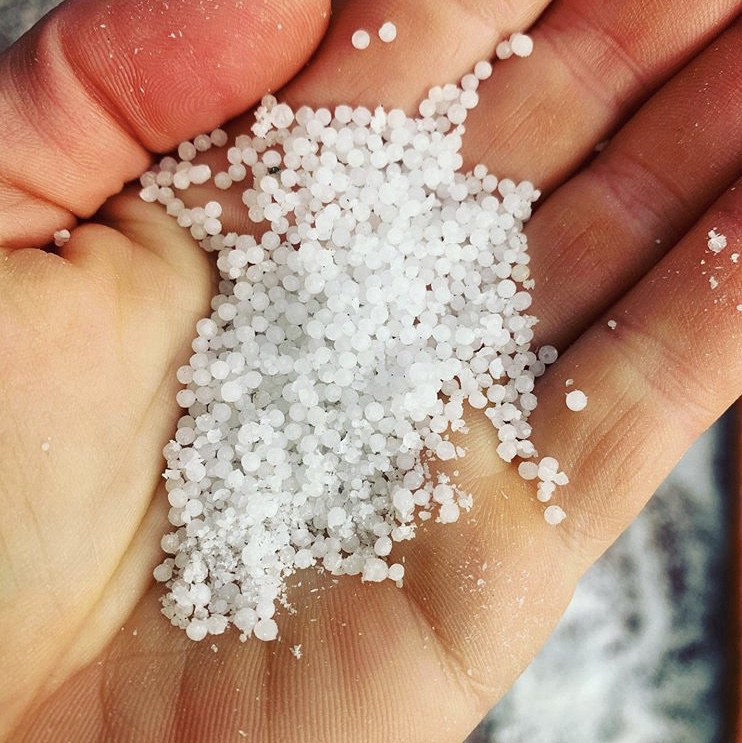
The fertilizer we load here in Kotka is UREA. Last year I had a bit of an allergy to it… They say it is not harmful but sometimes I doubt it… the next morning my face was all puffy. Luckily this year only my eyelids were, so I was still recognisable by my colleagues!

Urea Fertilizer

Sailing to Delfzijl 🇳🇱 is interesting. Not the navigation part, but the loading part… The vessel needs to be even keel as she goes through the very narrow sea locks upon arrival. 5,00m draught. Not more. This means that the loading needs to be very precise to be a few centimetres on the stern (we will burn fuel with a 4-day sailing and those tanks are situated on the aft part of the vessel). If we are not even keel, the chances are that we will get stuck somewhere in the locks. We also need to go in with high water, as at low tide there is not enough water (obviously 🧐). That is only a matter of time scheduling with the harbour master and pilot that needs to board the vessel for the inshore channel part.

Passing through the bridge in the inshore channels of Delfzijl

To be even keel when the loading belt drops 700t/h fertilizer in your hold and when the chances of rain are high doesn’t make the task as easy as it seems. Urea cannot afford to be wet: one drop of drizzle, the hatches need to be closed immediately. Fertilizer melts and when it dries out and it hardens which makes it very difficult to get rid of. We will see how it goes next week with the cleaning of the hold! It also makes the rails of the coaming very slippery and it is therefore very important to keep a very close eye on the trim of the vessel while loading so that hatches can be closed at all times. Well, this time there was a thin layer of fertilizer on the coaming and while I was closing hatch 9, I couldn’t move forward anymore! 😰I felt a bit of pressure and thought to myself: “oh no! is this happening now as we only have 20 minutes of loading time left and rain is soon coming? “Really??”. Luckily the captain was also on deck at that moment and heard me struggle with the wheels of the crane. He put a bit of sand and tried pushing but it didn’t work (sometimes a small push helps) but nothing moved. We did not have a big trim but it was still too slippery.

Fertilizer being loaded at a speed of 700tone per hour

In the beginning, I thought: “ Could this be ice on the coaming?”. It was only 2°C outside but felt like -3°C. No, it was the very thin layer of Urea dust. In no time the engineer and captain took two strops and the chain block and the crane ended up moving very smoothly like if nothing had happened. I must say my heart was beating a bit faster as the pictures of damaged cargo – so close to the end- were popping up in my head…. Shush pictures! We win. The crane moves, we close hatches and the rain only comes later.

Kotka harbour

It was nice to be back at sea for a few days again 🌊. I like to get into a routine sometimes: when my Marad jobs are done and I am up to date, it is very satisfying to be able to relax on watch and do some maths ( yes yes, maths exercises… without calculator…) and to read 📚. I finally had time to finish a great book (“All the Light we cannot see”) that one of my favourite Danish bosun offered me 5 years back. Thank you Peter J.!

Underway with finally a bit of calm sailing in the Baltic

We sailed through the Kiel Channel – once again- at night – once again (I know the routine by now and expect a 6 hour night watch instead of the usual 4, but that is the sailor’s life, and I do not mind!) and arrived t the sea locks in Delfzijl at 3 am on Friday. There also was a long night. As the captain was having a way longer time in the bridge, I offered to come earlier so that he could have a short 2-3 hour sleep before the tricky part of the river, the narrow locks and the channel. I think it is nice, also as captain you need your rest! Besides, Saturday afternoon and Sunday were then off as the discharging will only start on Monday morning. I would have time to catch up on some rest and do something else later! 🙂

Chief officer ready to moor in Delfzijl!

A Saturday afternoon filled with 2x 5km walk (back and forth to the city centre) and a small stop in a second-hand store where I found 7 chick books in Dutch… yes! To practice my dutch! And a few ingredients to teach cookie how to bake a carrot cake 🥕- better than the one from Starbucks!- my favourite cake. The agreement is that he would then teach me how to make sambal 🌶 and an Indonesian speciality ( also a cake… sweet tooth remember? 😉 )

His vegetables are really growing in the galley. It is cool to see and it reminds me of our lupine garden in the Bridge in my previous term! 🌱

The cook’s small vegetable garden in the galley…

A calmer week as you can see, but good to charge those batteries for my next 2 weeks left!

See you next week! Xxx Sophie 😘 ♥️