8th-14th of February 2021
We started the week ready to load timber. As I said. First-time timber so I was a bit curious and anxious. But to be honest, the idea is quite « easy »: it is to have the cargo hold as full as possible, as packed as possible with the least “empty space” in the hold, then the more cubics you will be able to take on deck.
Now… for the less easy part. All packages do not have the same size. That is the difficult part because of course, they do not all come ” by size” they come out of the shed in what I would think is a total disorganized way.
And did I mention also that the stability of the ship with timber has to be very very well anticipated and calculated to avoid the disaster of capsizing?… you should never underestimate the weight of the cargo you store on deck: it can get wet and the wood absorbs the extra humidity and therefore weighs more! You also have to be aware of the snow and ice. yeah. Told you … the «idea» is simple and easy but the reality demands quite some « on top of it » matter…
There is a bit of preparation to do before loading timber. Besides opening the hatches, we have to take all the hundreds of slings out of the forecastle where they are stored; but also all the tarpaulines, the heavy hooks and chains…. We have everything ready for the crane to take them ashore in the morning for the shore team to use. We take everything out with the hatch crane and the winch we have on the foremast.

The crane driver, together with a stevedore on the ship work together for getting the most of it. My job is to make sure they follow the loading plan accordingly so that I can empty my ballast tanks following a plan, but also to make sure they do their job correctly in avoiding big gaps and unwanted lost space, or extra unwanted layers of snow on top of the cargo because it takes space then melts. Once I see that they do it correctly I go and do some other maintenance jobs or administration, always keeping in mind that the cargo operation goes prior to any other job I might want to do. It is highly important to keep the ship safe and keep an eye on the trim so that I can close the hatches at any time and that I simply know what is happening at all times. The idea is that they are loading, of course, so I cannot ask them to discharge and load again. If I see something wrong, I should say it immediately otherwise it is too late. Eventually, I can ask them to “fix” things and tell them I am not so happy and that they have to do better.

The nice thing about timber cargo is that it is not dirty cargo. It is not dusty, not sticky. On the opposite, it really smells fresh like the woods! Also, because it is timber, it does not matter if it is raining or snowing. The packages are sort of protected by plastic wrapping you only have to watch out that they take off all the snow on the top of the packs before they put another tier. Snow takes place and it will eventually melt. So it creates a loss of space.
In Finland, there is one hour difference between the ship. So it is a very early wake-up. When it is cold and frozen, everything seems somehow slower: it takes me more time to open hatches and my finger does not follow as fast… Or probably the hydraulic oil of the hatch crane is just not totally warmed up either! Anyhow it is early. At 4am, I usually head towards my bunk and not on deck! But I have my routine once the hatches are open I either speak with the foreman or I quickly make myself a nice cup of coffee in the bridge. Usually, I have coffee just after because even if I am on time in the morning, I want to make sure there is no problem with the opening of the hatches. Sometimes the shore team is not there yet and is not ready, but at least I am.
The loading went very smoothly: with two cranes it is indeed quite fast. Once the cargo hold is full, that is when the tricky part starts. We close the hatches, speed locks and wedges, and while the deck crew prepares all the side tarpaulins, we take the drafts to make sure to calculate how much cargo we can take on deck. We will for sure have some ballast with timber, for stability. This is where most accidents happen with ships carrying timber cargo. The IMO has a whole recommendation book about it! Ships need to be certified to carry it.

Another thing with cargo timber… Is the lashing as I mentionned in the beginning of this story. Oh-my-god! There are the tarpaulins (glad that we have the light version:), the slings (single and double) the chains the hooks the side slings, the shackles, the timber for on top of the tarpaulins, the chain blocks to tighten the chains… Well… All his equipment is very heavy. And this is not a 2-hour job. The whole crew is on deck working. Even the Captain! (Well Captain H. is anyways always on deck!) but the cook too! It is a hard job, but fun, because we make it fun, of course. In the end, we are really tired, hungry too, but happy to go to bed. I am really glad that despite the cold, we did not have wind or snow or ice falling from the sky. This would have made this job extremely difficult and terrible. We got it finally done and I must say my poor muscles were already aching from having to store everything back three days later. We were told we would be doing a few runs between Finland and Brake (Germany) with timber… I better get used to it fast right? Good that it is not a weather-sensitive cargo: it can be loaded during rain. Indeed, it is stored outside on the quays in Finland so… no changes when we load. But luckily we were not disturbed by any rain that week. It was indeed quite nice weather: no wind, no snow, no ice droplets…. Cold – very cold! – but clear. I wouldn’t imagine being outside in a snowstorm during loading and lashing! When you have to take off your gloves to make tiny knots with the tarpaulins protecting the cargo…. Brr…
The deck lashing requires tarpaulins to protect a minimum from water so that the timber stays as dry as possible ( as I said earlier, it avoids extra unwanted water/ ice weight on deck), then we have a few timbers positioned on top of the tarpaulins, this prevents the wind from blowing in them. Then we have a lot of very big and long slings on each portside and starboard side that is fixed from the side of the coamings ( so directly to the ship’s structure) and brought on top of the cargo. These two slings are joined by two chains fixed and tightened by a locking hook. Trust me all these equipment are heavy (as much as heavy duty!) and you have to bring them around the deck back and forth and manipulate them. It takes hours to put everything in position and to fix and tighten everything. By the end of the lashing, your muscles are literally burning, and you cannot wait to go directly to bed. Well, at least that is what I thought. To fix the hooks and chains you need a small chain block; that tool is also heavy. In the first step of the procedure, you tighten it as much as possible by hand then with the chain which goes way faster. You always need two persons to do that as it requires some strength to hold the hooks in a good position and direction. Besides the thousands of steps and sweat in your back, you are also going up and down climbing on the cargo. Trust me, when I say it was a great workout, it really was. But imagine doing that in the winter with a few layers of warm clothing and winter overall…. You sometimes feel as Bibendum working his way through the ship…. Again, I am glad we had good weather and that we only had to fight the cold…. Suddenly the -17°C did not feel as cold anymore!

This was for most of the crew a first in timber deck cargo, for others, it had been years, so the lashing took quite some time, but we ended up finding our way through and getting better at it. I can imagine that if you do this every second week, it goes faster and faster because you end up finding tips and tricks to make your life easier. I was surprised and happy that we worked really well as a crew then to « just get it done » and do the work. I like teamwork. It reminds me of my times on the tall ships: if you didn’t pull on a line as a team, you would never get that sail high enough or sheeted in enough…. It’s all timing and working together to keep up the efficiency.
Ok, so there we were ready to leave Hamina – finally – and sadly (I started to enjoy the cold and the icy view here!) for Brake in Germany. I first got a bit tired of all the work it would request us but thought it was fine, that we just had to go for it. It is funny how your mind gets a bit troubled, or one-sided when colleagues of your say stuff as « oh so much lashing work for only 3 days sailing », ” it is so much work is not worth it”, “it is not nice”, blah blah blah… well; once you have that in mind, it is hard to get it out. I just thought « ok this is a first let’s give it a try and we will see » right? Although my sore muscles were telling me I didn’t like it at all, I tried very hard to fight my « devil brains » haha.
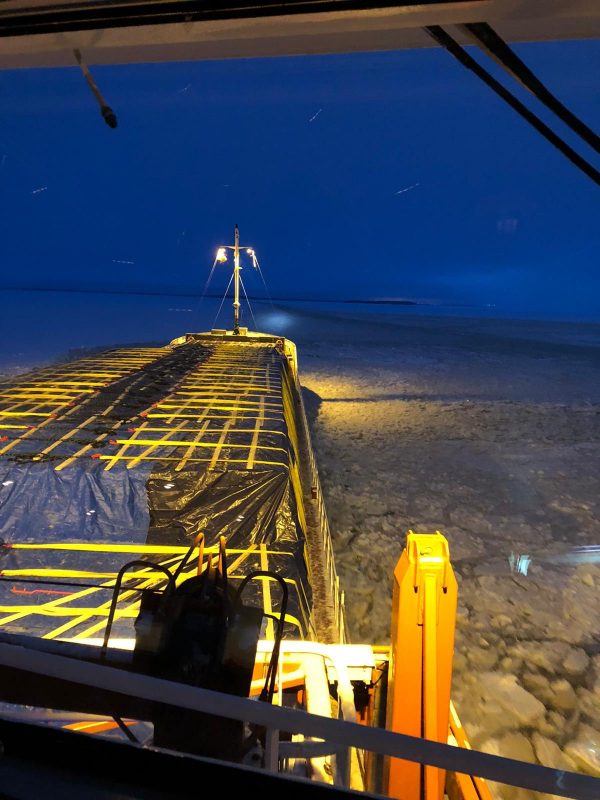
Ok, we are underway. Baltic Sea, Kiel Channel, North Sea and direction brake. It seemed colder there than in Finland actually… But it was only -5°C! Leaving Hamina was quite nice: at 17:00 it was already dark outside of the course and it was still icy. I really enjoyed the view. It seems that I am getting used to the ice and the freezing temperatures up here! We sailed to the Kiel Channel and most of the ice melted on deck as we were getting closer to the 0°C. The stability of the ship was very low which means that we were rolling like babies in our bunks. The total opposite of steel coils! The Kiel Channel was nice: peaceful. I had the second part and the second lock in Brunsbüttel: still cold but sunny weather: perfect to start ( or end in my case ) my day!
I would head to bed to be ready for mooring in Brake. The next morning early was beautiful! The river was amazing when the sun started rising because there was a lot of fog: probably the difference between the air and water temperatures! I really enjoy these small peaceful moments! The nice thing is that we arrived on a weekend and they were not discharging on Sundays! So there it was: my happiness of a Sunday in the harbour where we were allowed to go ashore too! A Sunday with a long walk, just to smoothen out the muscles, get the legs walking for over 100 meters in a row: perfect.


Brake was quite an interesting little city. Captain H, duschi the dog and I went for the grand tour through the city, then on the riversides. Lovely weather, nice architecture, nice company, good talks. I even got « upgraded » by the dog! Indeed she usually really hates me, except when I give her some pieces of my orange or when there are rough seas. But then this happened: I had to enter a hotel to ask if I could use their bathroom ( after over 2 hours walking… yes yes) and apparently Duschi was staring at the door and whining waiting for me! And when I came out she seemed all happy and captain H. said she had been waiting for me as if I was « part of her group » now…. Well not so fast Sophie. Remember it is still Duschi, the dog that hates other women because she is always so jealous that then talk to her property-master-owner-king-captain or whatever you name it. But it felt nice to be finally accepted by the dog – for that day!
We returned to the ship and had a good evening: the discharging would proceed early the next day and I would have to wake up very early again to open hatches…. So better get some more sleep and rest again!

See you next week! Will we be going as planned to Hamina again? Suspense suspense… I shall not say more!
Take care, my friends!
Xxx Sophie
 S O P H I E. T H E. S A I L O R.